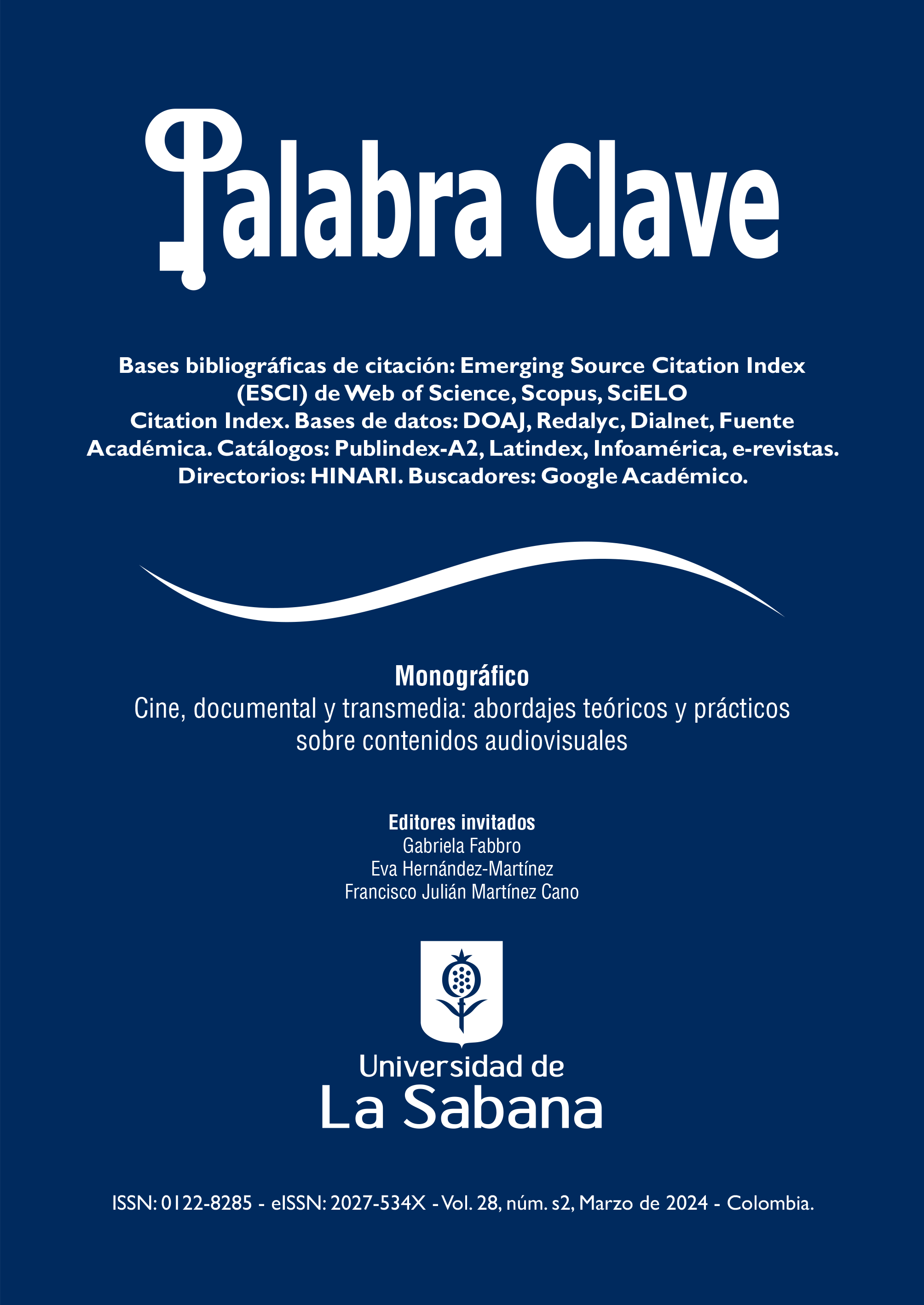
Cinema, documentary, and transmedia: theoretical and practical approaches to audiovisual content
DOI:
https://doi.org/10.5294/pacla.2025.28.s2.8Keywords:
Contemporary audiovisual art, media convergence, transmedia narratives, representation and experience, documentary and digital cultureAbstract
This editorial on the special issue “Cinema, Documentary and Transmedia: Theoretical and Practical Approaches to Audiovisual Content” examines the transformations of the audiovisual field in the digital era and how cinema, documentary, and transmedia narratives converge within a shared media ecosystem. New technologies have altered the ways images are produced, circulated, and consumed, making it necessary to rethink traditional theoretical frameworks as well as the relationship between memory, bodies, and representation. The special issue brings together studies ranging from European films of the 1960s to interactive documentaries and contemporary digital practices. Rather than offering a linear historical review, the editorial highlights common concerns such as the representation of reality, trauma, violence, and new spectator experiences. It also emphasizes how digital platforms and algorithmic environments encourage fragmented and personalized forms of consumption. Overall, the text proposes an interdisciplinary perspective on contemporary audiovisual media as a dynamic space where technology, aesthetics, and culture converge.
Downloads
References
Aiordăchioae, A., Pamparău, C. y Vatavu, R.-D. (2024). Lifelogging meets alternate and cross-realities: An investigation into broadcasting personal visual realities to remote audiences. Multimedia Tools and Applications, 83, 46707-46730. https://doi.org/10.1007/s11042-021-11310-3
Bresson, R. (dir.) (1966). Au hasard Balthazar [película]. Argos Films.
Egea, J. L. (dir.) (1964). El niño de Vallecas [película]. Escuela Oficial de Cinematografía.
Entrena-Serrano, C. (2025). Watch, scroll, repeat: How interface design shapes consumptive curation affordances on TikTok. Social Media + Society. https://doi.org/10.1177/20563051251358529
González Requena, J. (2006). Clásico, manierista y posclásico: Los modos del relato en el cine de Hollywood. Castilla.
Hernández Martínez, E. y Sánchez Vilela, R. (2021). Representaciones de España y Latinoamérica en producciones audiovisuales. MHJournal: Revista Internacional de Investigación en Comunicación, 12(2), 287-290. https://doi.org/10.21134/mhjournal.v12i.1424
Lotz, A. D. (2017). Portals: A treatise on Internet-distributed television. Michigan Publishing.
Marqués Rodilla, C. (2012). Sobre la ideología de Lacan. Trama & Fondo, 32, 75-92. https://dialnet.unirioja.es/descarga/articulo/4192935.pdf
Rodríguez Ortega, V. (2024). Audiovisual streaming, networked memory & Netflix: The spectator-interface. Creative Industries Journal, 17(3), 535-550. https://doi.org/10.1080/17510694.2022.2150814
Scolari, C. A. (2021). Las leyes de la interfaz: Diseño, ecología, evolución, tecnología. Gedisa.
Sorogoyen, R. (dir.) (2022). As bestas [película]. Arcadia Motion Pictures.
Widdicks, K., Hazas, M., Bates, O. y Friday, A. (2019). Streaming, multi-screens and YouTube: The new (unsustainable) ways of watching in the home. En CHI ‘19: Proceedings of the 2019 CHI Conference on Human Factors in Computing Systems Paper N.º 466, 1-13. https://doi.org/10.1145/3290605.3300696

Downloads
Published
How to Cite
Issue
Section
License
Copyright (c) 2026 Eva Hernández-Martínez, Francisco-Julián Martínez-Cano, Gabriela Fabbro

This work is licensed under a Creative Commons Attribution 4.0 International License.
1. Proposed Policy for Journals That Offer Open Access
Authors who publish with this journal agree to the following terms:
- Authors retain copyright and grant the journal right of first publication with the work simultaneously licensed under a Creative Commons Attribution License that allows others to share the work with an acknowledgement of the work's authorship and initial publication in this journal.