
| |
Artículos

Renata Barreto Malta 1
Aianne Amado 2
Érika Alfaro de Araújo 3
1  0000-0002-7414-9081.
Universidade Federal de Sergipe, Brazil
 renatamaltarm@gmail.com / renatamalta@academico.ufs.br
2 0000-0002-6754-2715.
Universidade de São Paulo, Brazil.
aianne_amado@hotmail.com
3 0000-0001-6283-9328.
Universidade Estadual Paulista, Brazil.
erika.araujo@unesp.br
Received: 27/06/2025
Submitted to peers: 12/08/2025
Accepted by peers: 07/11/2025
Approved: 09/12/2025
Para citar este artículo / to reference this article / para citar este artigo: Barreto Malta, R., Amado, A., & Alfaro de Araújo, E. (2026). Racism and Gender-Based Violence in Brazilian Sports Journalism: An Intersectional Approach. Palabra Clave, 28(4), e2841. https://doi.org/10.5294/pacla.2025.28.4.1
Abstract
This study examines the intersection of sports journalism and social issues in the Brazilian context, focusing on audience reactions to journalists' discussions of racism and gender-based violence in men's soccer. Using semantic network analysis, we examine user comments on social media to identify patterns of acceptance and rejection of these debates. Our findings reveal a marked resistance to incorporating social issues into sports discourse, particularly among segments of the audience accustomed to a depoliticized approach. Criticism is frequently directed at Grupo Globo and Sportv, often accompanied by political polarization and sexist and racist rhetoric. The findings contribute to broader discussions of sports journalism as a site where social hierarchies are reinforced or contested, underscoring the need for further research on representation, visibility, and the intersectionality of oppression in sports media.
Keywords: Journalism; sport; gender equality; racism; audience reactions.
Resumen
El presente estudio investiga la intersección entre el periodismo deportivo y las cuestiones sociales en el contexto brasileño, con un enfoque en las reacciones del público ante las discusiones periodísticas sobre el racismo y la violencia de género en el fútbol masculino. Mediante el análisis de redes semánticas, se examinan los comentarios de usuarios en redes sociales para identificar patrones de aceptación y rechazo en torno a estos temas. Los resultados revelan una marcada resistencia a incorporar cuestiones sociales en el discurso deportivo, especialmente entre sectores de la audiencia habituados a una visión despolitizada del deporte. Las críticas se dirigen con frecuencia a medios como Grupo Globo y Sportv y suelen ir acompañadas de una retórica sexista y racista, polarizada políticamente. Estos hallazgos contribuyen a debates más amplios sobre el papel del periodismo deportivo como un espacio donde se refuerzan o se cuestionan las jerarquías sociales, pero también destacan la necesidad de estudios adicionales sobre la representación, la visibilidad y la interseccionalidad de las opresiones en los medios deportivos.
Palabras clave: Periodismo; deporte; igualdad de género; racismo; reacciones de la audiencia.
Resumo
Este estudo investiga a interseção entre o jornalismo esportivo e as questões sociais no contexto brasileiro, com foco nas reações do público diante das discussões jornalísticas sobre racismo e violência de gênero no futebol masculino. Por meio da análise de redes semânticas, examinam-se os comentários dos usuários nas redes sociais para identificar padrões de aceitação e rejeição em torno desses temas. Os resultados revelam uma resistência acentuada à incorporação de questões sociais no discurso esportivo, especialmente entre setores do público habituados a uma visão despolitizada do esporte. As críticas são frequentemente direcionadas a meios como Grupo Globo e Sportv e frequentemente acompanhadas por retórica sexista e racista, politicamente polarizada. Essas descobertas contribuem para debates mais amplos sobre o papel do jornalismo esportivo como um espaço onde hierarquias sociais são reforçadas ou desafiadas, e destacam a necessidade de estudos adicionais sobre representação, visibilidade e interseccionalidade das opressões na mídia esportiva.
Palavras-chave: Jornalismo; esportes; igualdade de gênero; racismo; reações do público.
Introduction
"How could a victory on the lanes—or on the fields, in the gymnasiums, on the courts—be worth more than a decision about the political life of the country?" (Coelho, 2011, p. 8). The author's question refers to the early days of sports journalism in Brazil, within the context of print media, when doubts were raised about the relevance of sports as news. As soccer and other modalities gained popularity, sports journalism grew in prominence, became specialized, and expanded across print, radio, television, and the internet (Alfaro de Araújo, 2023; Ribeiro, 2007). Although sports journalism occupies media space, the spectacle-driven nature of sport often undermines its 'newsworthiness'—understood, following Gislene Silva (2005), as factors that shape news production. This view sustains the notion that social and political issues are irrelevant to sport or its coverage, reducing it to mere entertainment. One reason for this, as Lizandro Rincón (2016) suggests, is that communication studies have traditionally examined sports primarily through the lens of sports journalism rather than as a broader field of inquiry encompassing issues such as identity, fanaticism, violence, and nationalism. According to this author, journalism has generally treated sports as a subject of coverage aimed at reporting athletic performance, often with anecdotal, sensationalist, or entertainment-oriented tones, rather than approaching it as a field that requires serious, rigorous social investigation.
In 2018, then-journalist for Grupo Globo, Tiago Leifert, commented in his column on the GQmagazine website on the gesture of American football player Colin Kaepernick, who kneeled during the U.S. national anthem in protest against police treatment of Black people. He was categorical in stating: "Is a sporting event an appropriate place for political demonstrations? I don't think so (...) I don't think it's fair for him to hijack this moment, for which he is being paid, to promote personal causes" (Leifert, 2018). In that sense, we may ask: to what extent is a protest against racism considered a "personal cause"? For Leifert, consuming sports content serves the mere purpose of "disconnecting from reality." Journalist Juca Kfouri highlights the superficiality of such a notion by ironically claiming that
The poor news consumer can no longer stand so much filth in politics, so many crimes, and needs an oasis. Hence, the 'Leifertization' of sports programming on TV, where jokes abound and journalism sinks. Do not take this neologism as an offense to broadcaster Tiago Leifert, who took over the Globo Esporte program in 2009, but rather as a label for a trend that had been brewing for a long time and has now become an epidemic. (Kfouri, 2017, p. 34)
Historically, sports journalism has prioritized entertainment and the promotion of sport as spectacle to attract broad audiences (Padeiro, 2015), thereby sidelining debates about its historical, social, cultural, political, and economic dimensions. Against the grain, we assume that sport is a social configuration—structured through interdependent human groups (Dunning, 2013) —that influences debates on identity, politics, and popular culture (Billings, 2010; Rincón, 2016). As Heródoto Barbeiro and Patrícia Rangel (2006) assert, journalism is journalism, whether in sports, politics, economics, or social affairs, with its essence tied to ethics and the public interest.
Although sports journalism operates within a hegemonic system, it remains susceptible to transformations, in parallel with the growing space afforded to communication scholars to examine mediated sports as a social phenomenon. According to Rincón (2016), studies on mediated representations tend to focus on how identity—whether based on race and ethnicity, gender, nationality, or disability—is constructed in the media. These studies concentrate on identifying notable asymmetries, both quantitative (greater or lesser presence) and qualitative (concepts and evaluations), in media portrayals of these groups, particularly the recurrent use of stereotypical constructions and strategies of minimization and trivialization.
This broader perspective also shapes sports journalism, which now addresses issues such as racism and gender-based violence, prompted both by alarming data and by the involvement of athletes and other sports figures in related cases. Thus, it falls to sports journalism to address these issues with seriousness and to foster social debate, an effort that remains limited but is increasingly evident in Brazilian media. However, how have these efforts by sports journalists been received by an audience historically used to content that avoids social discussions, particularly those related to race and gender?
To address this question, as an empirical trajectory, we mapped nine videos published on Instagram by the sports channel Sportv (from Rede Globo) that discuss crimes of racism and gender-based violence involving Brazilian football players, with strong international relevance, and analyzed the audience's comments. Furthermore, from an intersectional perspective, we selected a corpus of videos featuring journalists who are affected by social markers of gender and race.
Racism and Gender-Based Violence in Brazilian Soccer
In 2024, the imprisonment of former Brazilian soccer player Robinho— convicted in three instances by the Italian justice system for gang rape— and the conviction of fellow former player Daniel Alves for "sexual assault" by the Spanish courts, a crime equivalent to rape in Brazil, sparked discussions about gender-based violence in sports.
Both cases dominated news headlines, but they were not isolated incidents. Numerous cases of sexual assault have tainted the world of soccer, forming part of a broader landscape of violence that includes domestic abuse and femicide. A stark example is the 2010 murder of model Eliza Samudio, ordered by then-Flamengo goalkeeper Bruno Fernandes. The case resurfaced in 2020, when Bruno returned to professional football while serving his sentence under a semi-open regime.
A similar pattern—where specific cases ignite broader social discussions—can be observed in the incidents involving Brazilian soccer player Vinícius Júnior, who plays for Real Madrid and has been subjected to persistent racist attacks. These incidents, ongoing for years, include racist chants from fans, monkey noises (ESPN Brasil, 2023), and racist remarks in Spanish media, such as being told to "stop acting like a monkey" (Lopes, 2022). In March 2024, during a press conference, Vinícius Júnior made an emotional speech that resonated worldwide. As reported by Cahê Mota (2024), he expressed exhaustion at having to fight racism alone and file numerous complaints that led to no punishment.
Three months later, three Valencia "fans" were sentenced to eight months in prison, fined, and banned from stadiums for two years. In response, Vinícius Júnior published on social media that many had urged him to "ignore" the incidents and "just play football," countering: "I am not a victim of racism; I am a tormentor of racists." He stressed that this first criminal conviction for racism in Spanish football "was not for me, but for all Black people," and warned that "other racists should feel fear, shame, and hide in the shadows. Otherwise, I will be here to hold them accountable" (Vinícius Júnior, 2024). Shortly afterward, Real Madrid reported a new sentence for racist attacks against Vinícius Júnior and religious insults against Antonio Rüdiger. These were the first racism convictions in the history of Spanish football.
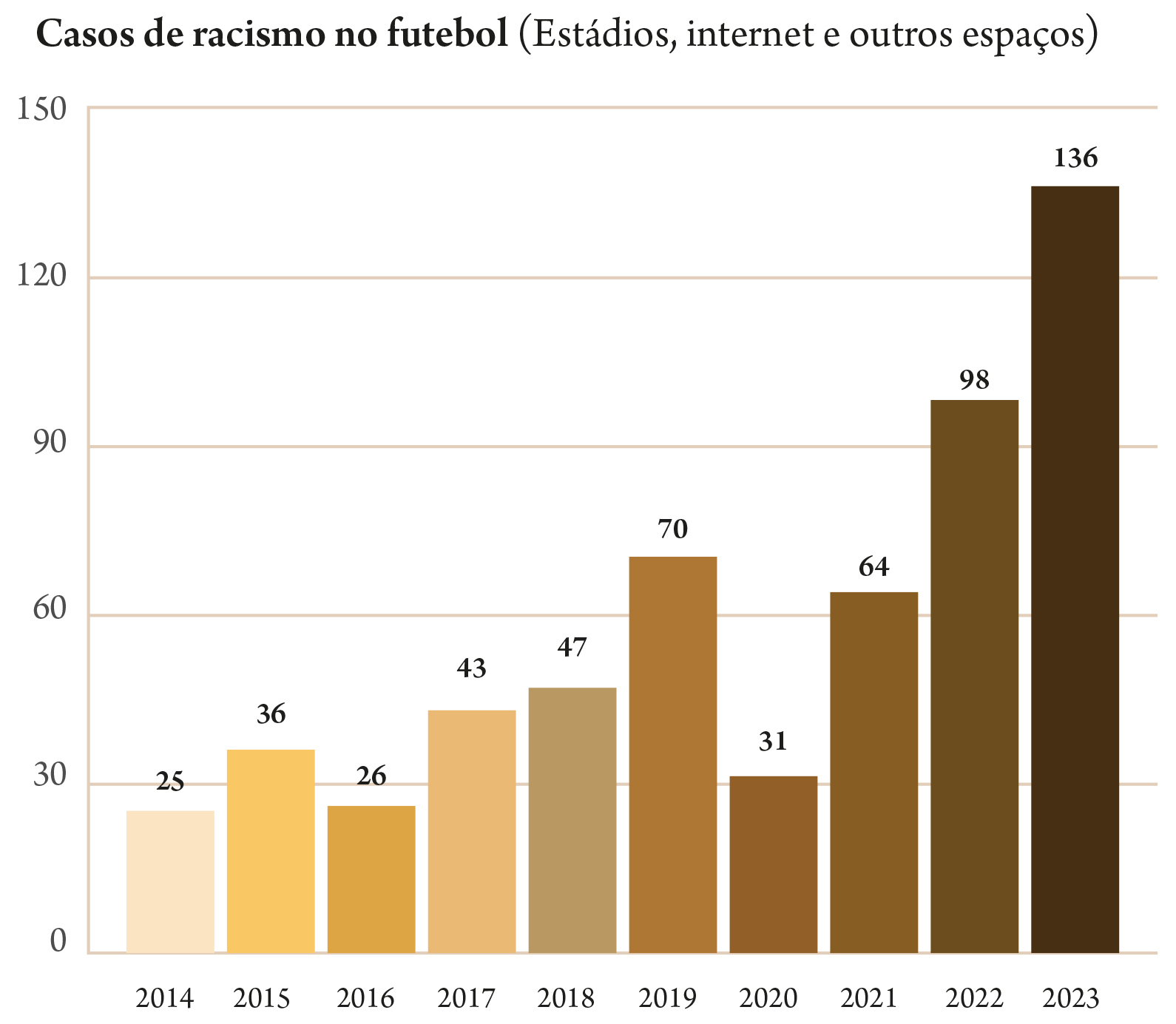
The data confirms that these are not isolated incidents. Since 2014, the Observatory of Racial Discrimination in Soccer has published an annual report analyzing discriminatory acts in sports, both within Brazil and involving Brazilian players abroad. According to the report, in 2014, 25 cases of racism were documented in Brazil, totaling 36 when including incidents abroad. In the most recent edition (2024), the number had increased by more than 500 % over a decade of monitoring (Figure 1).
Figure 1. Racism Incidents in Brazilian Soccer
Source: Taken from Observatório Racial do Futebol (2024).
Gustavo Bandeira (2024) suggests that the rise in reported cases reflects a growing recognition of different forms of violence—an essential step in confronting them. For him, claiming that Brazilian soccer is more violent today than ten years ago means acknowledging that behaviors normalized in 2014 are now reported, contested, and prosecuted. The report also notes that its figures represent "only the tip of the iceberg," as they capture only incidents covered by the media. "The incidents documented in our reports prove that we do not live in a country where people of different races, origins, genders, and sexual orientations coexist peacefully and empathetically" (Observatório Racial do Futebol, 2024).
Material and Methods: Empirical Path
Given the outlined scenario, this study aims to analyze the reception of digital publications by Sportv, a channel owned by Grupo Globo, which addressed cases of racism and gender-based violence. Considering the relevance of gender and race markers, we adopt an intersectional analytical perspective, as suggested by Patricia Hill Collins and Sirma Bilge (2021). The authors observe that oppression is based on three interdependent dimensions: one related to labor exploitation, the second to the political sphere (inequality in the justice system, access to public positions, among others), and the last to the ideological sphere, directly linked to media representation.
Collins and Bilge (2021) argue that one of the main reasons why the viewpoints of oppressed groups are suppressed is that self-definition can foster resistance. Consequently, strategies are employed to silence their perspectives, experiences, and claims. The experiences of an oppressed group, such as those reported by Vini Jr., can position its members to perceive oppression differently, but the lack of control over society's ideological apparatus, including the media, makes it harder to express a self-defined point of view.
Carla Akotirene (2019) posits that intersectionality provides a theoretical-methodological framework to address the structural inseparability of racism, capitalism, and cisheteropatriarchy, which shape identity avenues—where Black women are repeatedly impacted by the intersection and overlap of gender, race, and class, as modern colonial apparatuses. In response to situations such as Tiago Leifert's comment, which perceived the protest as a "self-interested cause," and to the media exposure of racism denounced by Vini Jr., intersectionality rejects isolated identity claims disconnected from collective struggles and is useful for recognizing racism, sexism, xenophobia, and contextually redefined oppressions.
Based on these principles, this study selects as its corpus all videos posted on the official Sportv Instagram account between January and April 2024 that address racism or gender-based violence in sports and are presented in an opinionated tone by a single journalist, totaling nine media pieces. These videos are excerpts from television programs, published digitally in the Reels format, and share a similarly critical stance on the themes discussed. The selection ofvideos featuring only one commentator aims to analyze to what extent the race and gender markers represented in the journalist's figure (Black female journalist, White female journalist, Black male journalist, White male journalist) are significant and influence not only the nature of user comments but also the tone of discourse. Accordingly, 13,386 comments were manually collected, representing the total sample.
To handle such a large volume of content, we opted for the quantitative methodology of semantic network analysis, previously applied by the authors (Barreto Malta et al., 2019; Barreto Malta et al., 2020; Barreto Malta et al., 2024). James Danowski (1993, p. 198) explains that, in this technique, instead of categorizing messages, one can map relationships among words. By defining link strength as the frequency with which two words co-occur, each word pair exhibits an occurrence distribution ranging from zero upward. Using these data, it is possible to construct a network of words that, through established semantic connections, indicates the main discursive lines in the analyzed material, enabling objective analyses of word proximity beyond mere frequency analysis.
To achieve this, the collected comments were divided into four groups based on the characteristics of the journalists presenting the corresponding posts: (1) Black women; (2) White women; (3) Black men; (4) White men. Each group's comments were processed using the Wordij system (Danowski, 1993), and the results were analyzed in Gephi (Bastian et al., 2009), which enables the creation of interactive networks. In these networks, each term corresponds to a node, whose size is determined not by word frequency in the textual content (in this case, the comments) but by the number of connections it forms with other terms—meaning that the more pairings a word creates, the larger its node. These pairings are represented by edges (lines between nodes), and the thicker the edge, the more frequently it appears in the text. The nodes are divided into clusters, thematic groupings identified by the software and represented in different colors.
Thus, the network enables us to observe the primary semantic directions of the material, which are described in the following section and illustrated with excerpts from comments drawn directly from the corpus for each analyzed category.
Results and Discussion
Group 1: Black Female Journalist
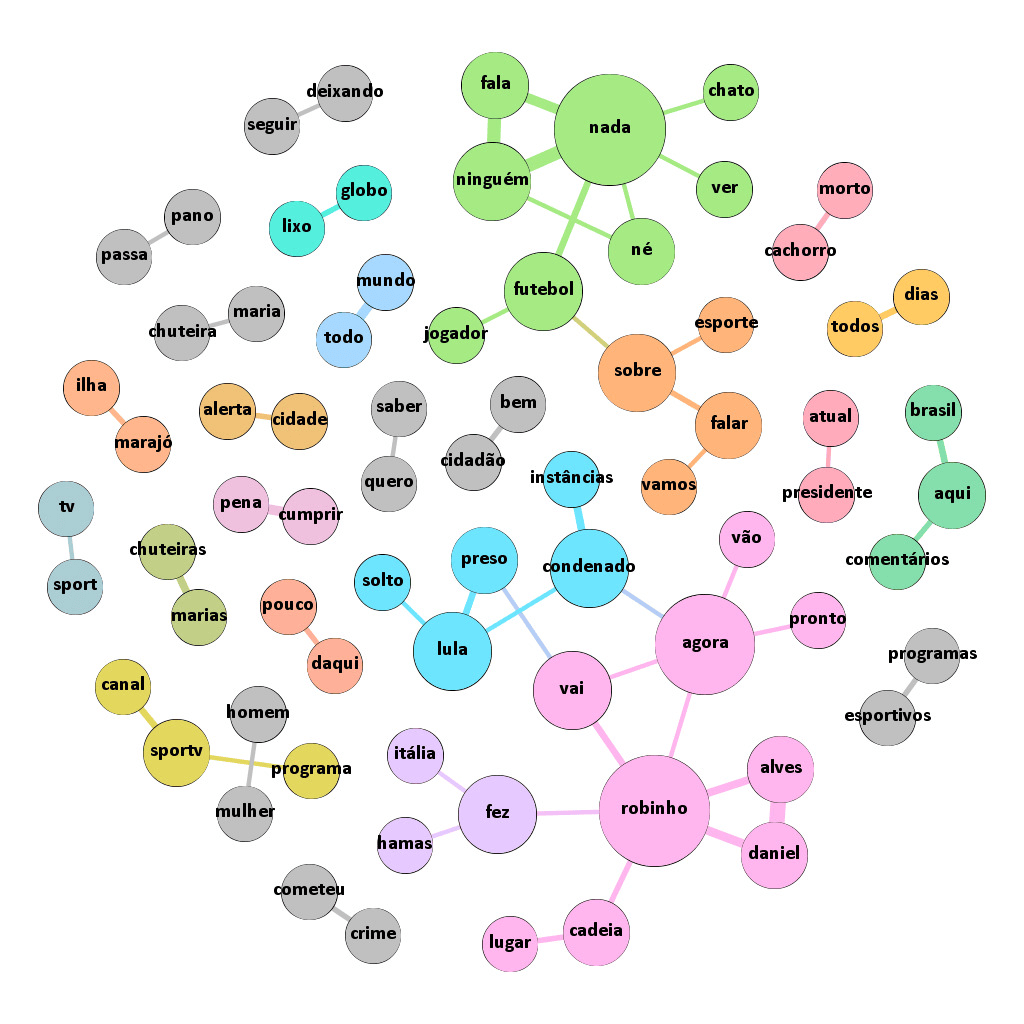
Only one video within the selected corpus featured a Black female journalist, specifically Rafaelle Seraphim, who, in a publication on March 21, 2024, discussed the case of the athlete Robinho. As of the data collection period (May 2024), the post had 955 comments, distributed in the semantic network below (Figure 2):
Figure 2. Semantic Network of 955 Comments on a Post Featuring a Black Female Journalist
Source: Own elaboration.
The largest node in the network corresponds to the name Robinho, which is directly connected to nodes indicating the name Daniel Alves, as well as prison, which, in turn, is linked to place, indicating that a portion of the comments believe the players should remain incarcerated. Robinho's name is also associated with the term now—a large node due to its multiple applications, ranging from the expression "now it's settled,' indicating dissatisfaction, to statements asserting that the player will now be imprisoned and convicted in various courts.
The node convicted also shares edges with the name Lula, which, in turn, is linked to prisoner and released, indicating that the debate surrounding the legitimacy of the Brazilian president's release (following the Supreme Federal Court's decision in November 2019) is still ongoing. Comments such as "Will Lula be arrested too?" and "I just want to know one thing, why is Lula still free?" illustrate this association, which tends to divert attention from the central case and generate a parallel debate. A smaller cluster, formed by the nodes current and president, reinforces the presence of this argument.
The country's political polarization divides the comments, even though no political candidate is mentioned in the video. Users associate those defending Robinho with supporters of former president Jair Bolsonaro, as illustrated by the comment: "I just came to see the Christians mopping the floor of [Brazilian expression for excusing] a rapist, just because he supports the ineligible [referring to ex-president Jair Bolsonaro]. It's disgraceful what they've done to Christianity in Brazil."
The second-largest node in the network is the word nothing, which is primarily related to complaints that, on a sports page, no one talks about soccer anymore—this node, in turn, is connected to let's, talk, about, and sports. The cluster also includes the term boring, demonstrating that the audience is dissatisfied with the social debate extending beyond the strictly sporting sphere, as pointed out by a user who writes: "Let's talk about soccer. Crime, whether committed by a player or any other professional, is not a topic for a sports channel!! This is really boring.."
Faced with this dissatisfaction, viewers criticize the Globo network, associating it with trash and comparing it to the police show Cidade Alerta for "beating a dead horse" by discussing the issue every day. Some comments mention unfollowing the Sportv Instagram page. This segment of comments can be linked to the previously discussed idea that soccer has historically been positioned as an exclusive space for entertainment. In this sense, two considerations emerge. The first is the internalization and normalization of a logic that separates social issues from sports journalism. The second is the hegemonic groups' denial of social problems such as racism and sexism. Thus, men (who make up the majority of the audience in question) may be unwilling to reflect on sexism, and white people may be unwilling to acknowledge racism. Grada Kilomba (2019) helps us understand this rejection of the debate. The author argues that:
Beyond the mask, there is a disturbance caused by it: What could the Black subject say if their mouth were not covered? What would the white subject have to hear? Would they be forced into an uncomfortable confrontation? That which is "kept silent as a secret." Secrets such as colonization, enslavement, and racism. (p. 38)
Thus, we are witnessing a refusal to recognize external reality because it is relational—racism requires the presence of racists, and sexism requires the presence of sexists.
Returning to the analysis, we observe comments that shift the focus to the crime's victim, characterizing them as women interested in the player's fame and fortune, referred to as Maria-chuteiras (a Brazilian slang term for women allegedly seeking relationships with soccer players for financial gain). An example is the comment: "We also need to teach our players to stay away from the famous Marias-chuteiras [gold diggers and schemers]." These comments, in fact, invert the logic of the crimes, especially those related to rape committed by soccer players. They suggest that players are often victims of women interested in their wealth and must be "careful" to avoid such situations.
In their study, Ana Carolina Vimieiro and Natália Souza (2022) show how telenovelas frequently portray women associated with football through the Maria-chuteira stereotype. They argue that such representations may help legitimize violence by men—and especially by male athletes—against the women with whom they relate (p. 15). The analysis of these representations, combined with the comments in question, prompts us to reflect on masculinity as a product of men's social interactions with other men. It is implicit that comments defending players and stigmatizing victims are directed at other men, even though this cultural construction may, to some extent, be internalized by women. As Benedito Medrado and Jorge Lyra (2008) note, men's collective power is sustained not only by individual attitudes but also by broader social institutions. Within this dynamic, the media plays a key role in maintaining and reshaping gender representations.
Group 2: White Female Journalist
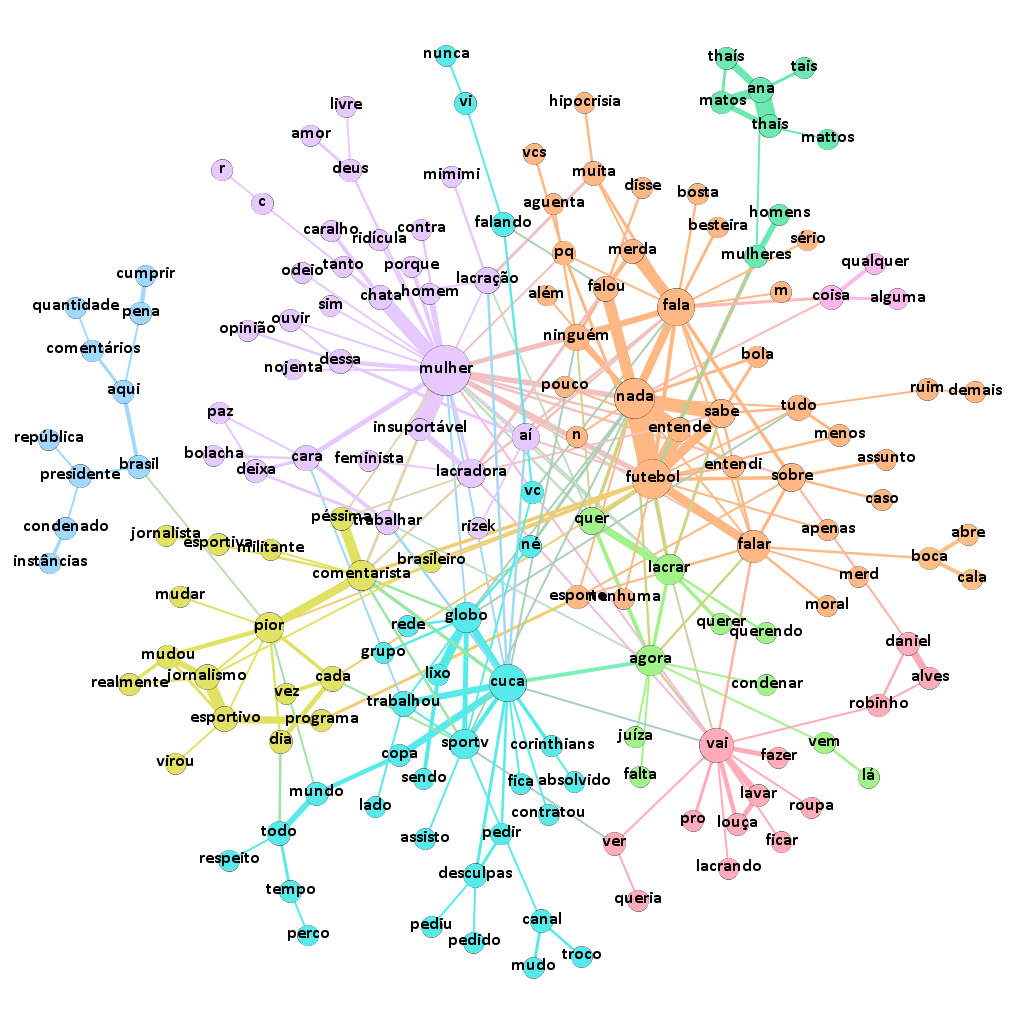
Two of the collected videos are presented by the same white woman, journalist Ana Thaís Matos. In the first, published on March 11, 2024, she discusses former player and coach Cuca's apology and the observed changes in sports journalism. As of the data collection period, the video had 4,661 comments—the highest number in the sample. The second video, from March 20, addresses the sexual violence case involving Robinho, with 493 comments (Figure 3).
Figure 3. Semantic Network of 5,154 Comments Found in Two Posts Featuring a White Female Journalist
Source: Own elaboration.
Due to the larger volume of textual content, we now have a more complex network, with clusters more interconnected through a greater number of edges between nodes. Unlike the previous network, this network emphasized the journalist's gender. The largest node corresponds to the word woman, which has stronger connections with the terms unbearable and annoying, also linking to hate, show-off, feminist, disgusting, and ridiculous. The node commentator, in addition to its parity with woman, is linked to sports, terrible, activist, show-off, and worst. This indicates widespread disapproval of the journalist's performance, as shown by comments like "This woman is annoying, disgusting, unbearable, and a lousy professional. You know what makes me even angrier? No one at the table goes against her (...)" and "Fucking show-off, what a disgusting woman" The understanding here is that the female journalist wants to show off by addressing these cases, suggesting that she should "Shut up and go wash the dishes!" and "Go wash some clothes" They are also questioning "who is Ana ThaísMatos in sports journalism and in the 'good queue'? She married the president of a samba school in São Paulo and now thinks she's the first lady. Get a grip." Comments also address her physical appearance, such as "and that cookie face, did she get Ditto [sic] now... unbearable and still thinks she's something... I feel bad for her colleagues who have to put up with this one talking, ugh."
The comments directed at the journalist not only disqualify her as a professional but also insult her, explicitly expressing a rejection of her presence. Furthermore, messages that imply the journalist's place is at home or in domestic roles are inherently sexist. When seeking arguments to expel her from a space considered masculine (soccer), users are aggressive, relying on her physical appearance and on socially assigned roles for women, which are constructed based on the sexual division of labor (Hirata & Kergoat, 2007). Among the offensive terms, we identify the adjective feminist, which can be interpreted as an insult. When comparing our network results with those of Barreto Malta et al. (2024), who examined reactions to Ana Thaís Matos during the Qatar World Cup, we observe that, regardless of what she says, users reject her presence in sports journalism. The supposed knowledge of soccer—ranging from technical aspects to lived experiences within the sport—would serve as an argument to exclude most women from this environment. Specifically in this study, the journalist's criticism of gender-based violence committed by athletes makes her an even more vulnerable target.
In their reception study conducted a decade ago in Cuba, Diana Pino and Sarah Martín (2016) highlight how women were not perceived as legitimate actors in the sports media sphere. Their findings reveal a set of persistent gender stereotypes that shape audience expectations: women are seen as newcomers to the field, assigned to less prestigious segments of sports journalism, valued primarily for their physical appearance, and rarely considered capable of performing commentary analysis. Such views are rooted in enduring cultural constructions that link sports knowledge, authority, and analytical competence to masculinity. While Pino and Martín's conclusions emerge from audience reception, our study—focused on online comments—demonstrates that many of these representational logics persist in digital environments. The hostility, rejection, and delegitimization expressed in comment sections reproduce the same cultural constructions identified by the Cuban authors. In this sense, the significant volume of aggressive messages directed at Ana Thaís Matos can also be interpreted as a reaction to her presence precisely in the opinion-based spaces that, in the Cuban study, male respondents acknowledged as legitimate only for male journalists. This parallel underscores that a gender barrier persists in sports journalism, where women's authority and expertise continue to be contested.
Returning to the clusters, dissatisfaction with the presence of social issues in sports journalism is evident across the network. The node journalism indicates that users believe Brazilian sports journalism has truly changed for the worse, establishing links with all these terms. The node soccer forms strong connections with nothing and with the verb talk in its various conjugations. Still within this cluster, identified in orange, the network reports complaints that no one on the panel knows or talks about soccer or sports in general; that the journalist only talks nonsense, garbage, or bullshit, and that no one can stand it anymore; and that the coverage is terrible. Comments such as "Wasn't her specialty soccer?! She knows nothing about soccer, and now she wants to play judge?!" and "The history of sports journalism changing for waaay [sic] worse. By the way, missy here doesn't understand anything about soccer. Sportv is globolixo [Globo trash] indeed." Regarding Grupo Globo in particular, once again we observe a connection with trash, as well as a link to the node associated with former player Cuca, who also worked as a sports commentator for Sportv during the 2018 World Cup. The node Sportv also pairs with mute, switch, and channel. Here, beyond the discussion of the sexual division of labor (Hirata & Kergoat, 2007), which excludes women from sports journalism through separation (as a masculinist space) and hierarchization (where men maintain prestige and recognition), we also observe negative commentary directed at the institution itself. The purported deviation from topics directly related to sports serves as an argument for harshly criticizing Grupo Globo, thereby indirectly targeting the journalist who made these comments.
Finally, the leftmost cluster, represented in dark blue, focuses on discussions of the current president of Brazil (or the Republic), as in the previous network.
Group 3: Black Male Journalist
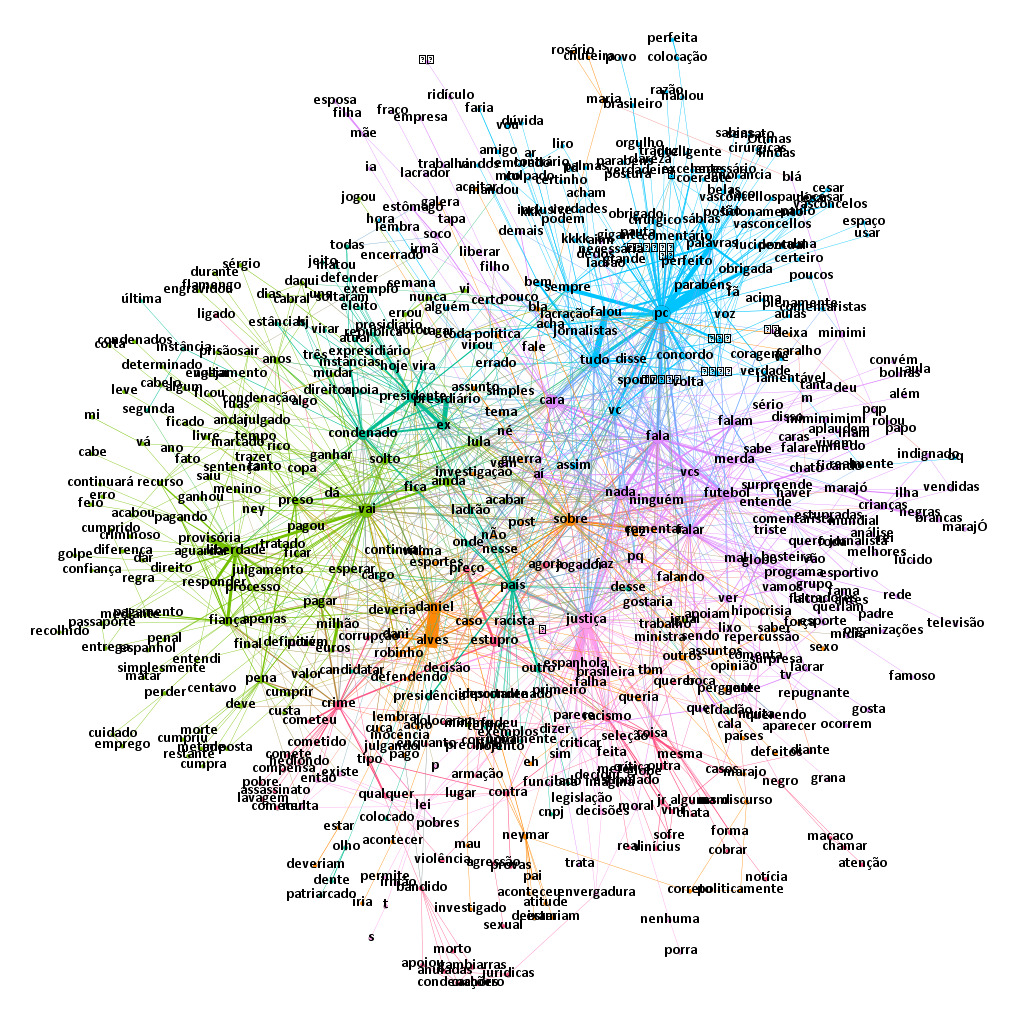
Three videos in the corpus feature Black men in a central role. Journalist Luiz Teixeira leads two videos in the sample: one published on March 27, 2024, addressing racism in the classic match between Spain and Brazil, and another on April 3, specifically about the case of goalkeeper Cheikh Kane Sarr from the Spanish team Rayo Majadahonda, who was suspended for two games after fighting back against fans who hurled racial slurs at him. These videos gathered 1,282 and 329 comments, respectively. Meanwhile, Paulo César Vasconcellos appears in a video published on March 20, in which he discusses the Daniel Alves case, which garnered 2,728 comments (Figure 4).
Figure 4. Semantic Network of 4,339 Comments Found in Three Posts Featuring Black Male Journalists
Source: Own elaboration
Notably, despite having fewer comments than the previous network, which referred to a white female journalist, this network appears even more complex. This is due to the diversity of themes and approaches within the comments. Here, we highlight only the semantic lines that relate to the research objective. The largest node in the sample corresponds to the nickname PC, attributed to Paulo César Vasconcellos. Unlike female journalists, the journalist receives positive comments about his speech, showing parity with praises such as perfect, giant, great, precise, excellent, coherent, necessary, intelligent, and accurate. The connections also indicate that users claim to agree with everything the journalist said, considering him one of the few commentators who has the courage to expose the truth with his wise words. They highlight his lucidity and praise his stance, calling him a source of pride for Brazilians. Other nodes associated with him include congratulations and thank you. The following comments exemplify the congratulatory tone: "Perfect, PC, as always in other situations. Wise and precise words. After spending the day disgusted by these news stories, it's a relief to hear him"; "PC is a Brazilian pride, a Carioca pride, and a pride to have such a lucid and necessary Botafogo fan."
It is interesting to note, however, that while PC Vasconcellos has the largest node in the network, journalist Luiz Teixeira has no node at all.
We identified that, in general, the pairings referring to him appear under the node dude, highlighting the disparity in recognition and prestige between the journalists. When referring to Luiz Teixeira, the dude node is connected to annoying, talks, crap, knows, and nothing, as demonstrated by the comments: "This dude only talks about this!" and "Shut up, show-off. This is getting annoying, dude, with such pathetic content. Look at Real Madrid's team and the number of Black players, but they provoke Vini. Show-off culture, which, by the way, no one talks about, but he plays nothing in the national team." Another node that refers exclusively to Luiz Teixeira is hair, which pairs with go and cut. The journalist wears dreadlocks, which appear to displease the audience: "Go cut that hair before appearing on TV"; "Cut that horrible hair"; "Go cut that hair and stop playing the victim."
The second-largest node corresponds to the term justice, referring to debates about the Spanish legal decision that allowed a price to be set on Daniel Alves' freedom, even though he was accused of committing a crime, rape. In a weaker connection, the node also establishes parity with president, which in turn links to Republic, Brazil, Lula, prisoner, convicted, released, defend, and voter—following a semantic path similar to that identified in previous categories. However, in this network, we find a topic deviation not present in the others, related to the sexual exploitation of children on Marajó Island, an issue highlighted at the time by former Bolsonaro minister Dam-ares Alves, revealing an alignment between topics. The comments express outrage that no one talks about this, not even Globo: "It's expensive [referring to Daniel Alves' bail]; a prostitute here costs much less. On Marajó Island, children have been raped for a long time, and you show-off people say nothing'; "Funny how they're not outraged about the children in Marajó who are sold every day, but now they want to make a scene about this case."
The discussions raised by the map are less evident than in previous ones. First, we ask why the reactions to Paulo César Vasconcellos' and Luiz Teixeira's speeches were so different, considering that the videos themselves contain similar content and tone. The first clues are based on the recognition and prestige attributed to Paulo César, known as PC. Since Luiz Teixeira does not have a node with his name, he is not recognized. We thus consider that PC has a long-standing career, previously dedicated almost exclusively to commenting on football matches, and his recognition would be significant in legitimizing a critical stance on social issues associated with the sports world. On the other hand, although not yet a well-known name, Luiz Teixeira emerges in the sports scene amid the rise of social issues and, to some extent, is stigmatized by them. It is true that we face a methodological limitation due to the corpus of analysis, but its materiality—naming and praising one while rejecting the other while speaking similar messages—cannot be considered a mere hypothesis.
A second issue deserves our critical attention. Directed at Luiz Teixeira, several comments criticized his hair, which, when styled in dreadlocks, is perceived as an expression of racism. It is notable that there are no racist comments aimed at PC, who is older and wears a shaved head. Furthermore, the racist posts about Luiz Teixeira's hair disqualify him as a journalist based on his "appearance," considering it inappropriate for television. Emerging from the analysis, this discussion can be deepened by drawing on Homi Bhabha's (1998) contribution, based on Frantz Fanon. According to Bhabha, identification is never the affirmation of a pre-established identity; it is always the production of an image of identity and the transformation of the subject when assuming that image. In this sense, identification means "being for another" (p. 85). By wearing dreadlocks, an expression of Blackness, Luiz Teixeira becomes the target of racist attacks. It becomes impossible not to recognize him as a Black man.
Group 4: White Male Journalist
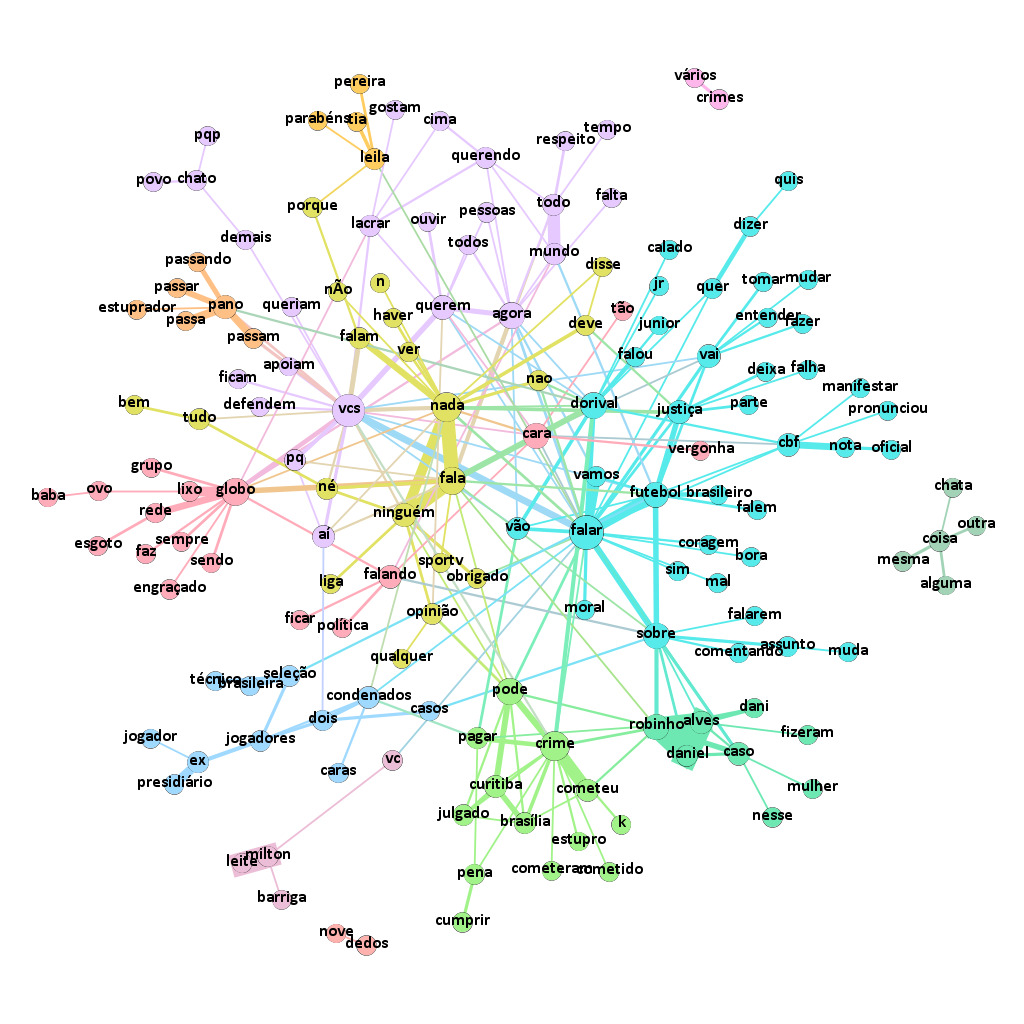
The final three videos in our sample feature three white male journalists: Alexandre Lozetti, in a video published on March 22, 2024, with 170 comments; Milton Leite, in a publication from the same day, with 2,719 comments; and Carlos Eduardo Eboli, in a video from March 28, with 49 comments. All these videos simultaneously address the cases of Robinho and Daniel Alves, with Milton Cunha's speech being more specifically about a statement issued by the Brazilian Football Confederation (CBF) regarding the case (Figure 5).
Figure 5. Semantic Network of 2,930 Comments Found in Three Posts Featuring White Male Journalists
Source: Own elaboration.
It is noted, through the network, that the comments seem to replicate the same semantic directions observed in the previous categories, whether in the request to let's talk about soccer (change, subject, same, thing, boring), in the classification of Grupo Globo as trash or sewer, in the claim that everyone is trying to show off on the discussed issues, and in the segment that criticizes those who defend [mop the floor for] rapists. It is evident that negative comments are directed at Grupo Globo and Sportv. We highlight that the nodes Lula and president are not present, although we still find an allusion to him with the parity nine fingers and ex-prisoner, clearly referring to Lula.
The only journalist mentioned in the network is Milton Leite, who is associated with belly—and was dismissed from Rede Globo after the 2024 Olympics. Leila Pereira, president of Sociedade Esportiva Palmeiras, also appears and is called aunt by Instagram users, who congratulate her for her statement (the CBF's official note came shortly after Pereira harshly criticized the institution's passive stance). Some examples of these parities are: "Milton's belly is as big as the hypocrisy of our judiciary and shown off press"; "Did anyone notice Milton Leite's belly? MY GOD"; "They're only speaking out now! Because of Leila Pereira, who had the courage to speak. Congratulations, Leila, you were brave"; "It took Aunt Leila to give them a nudge, huh?"; "And where's the congratulations for the Palmeiras president, who took a stand and was more of a man than those cowards running the CBF? Congratulations, Aunt Leila!"
It seems relevant to us that the comments directed at Milton Leite's physical appearance, a recognized name in sports journalism, frequently appeared on the map. Observing the nature of the comments, we interpret that, although prejudiced, they seem more associated with discomfort over the journalist's bodily changes—being followed for years by the sports audience—than with an actual attempt to disqualify him as a professional. We did not observe associations with insults or criticism of his performance, nor with nodes expressing discontent with his on-screen presence. In fact, there is no node on the map questioning or delegitimizing white journalists in a direct way.
Even though it is not part of our objectives, we are struck by the positive comments directed at Leila Pereira, the only woman to lead a men's soccer club in Brazil's 2025 Série A championship. The duality between calling her Aunt Leila and positioning her as more of a man than other sports directors warrants a separate analysis, which is not possible in this article.
Conclusions
This study examined a pressing issue: the historical spectacularization of sports, reducing them to mere entertainment and sidelining discussions inherent to a phenomenon that extends beyond the media and encompasses economic, social, cultural, and political dimensions. Our focus was on men's soccer, and we started from the premise that sports journalism is a fertile space for debates, stances, and demands on social issues. Although discreet, we observed that the responsibility to address them has, to some extent, been present in Brazilian news and sports programs. We found that the repercussions of international cases of sexual violence and racism involving Brazilian athletes and former athletes were the main drivers of this presence. Based on this scenario, we asked: how have the positions taken by sports journalists been received by an audience historically accustomed to coverage that does not engage in social debates?
From an empirical perspective, we first point out that an intersectional analytical approach proved significant for observing consonances and divergences in user reactions to similar positions taken by journalists marked by social categories such as race and gender.
A close analysis of the four semantic maps produced from such a broad dataset reveals social differences at the core of society and their presence in sports journalism. Through the analysis of semantic networks, we conclude that our hypothesis is confirmed: there is public rejection of the intersection of sports and social issues such as racism and gender-based violence. We consistently observed clusters, indicating strong criticism of Grupo Globo and Sportv. More broadly, we identified comments that deviated from the proposed debate, bringing unfounded associations with Brazil's political context. We also found sexist comments from users questioning female victims and portraying them as opportunists and dishonest. The reaction to these comments was visible in some nodes, with expressions such as "defending rapists," indicating that sexist statements trigger responses.
We observed that videos led by male journalists were the only ones that received praise and explicit agreement with their message. In contrast, female journalists faced constant attempts to invalidate their professional competence and their right to form opinions or occupy the role of sports presenter/commentator, exacerbating sexism. Particularly in the case of journalist Ana Thaís Matos, there was clear repulsion toward her, with arguments rooted in gendered divisions of labor and direct, unfounded, offensive remarks. Quantitatively, the publication featuring Ana Thais had the highest number of comments and the most aggressive content.
Ana Thaís's visibility is a contextual factor that must be considered. She is a pioneering journalist who serves as a commentator, specializing in analysis/opinion, and participates in various programs—from open-channel (Globo) to subscription-based (Sportv)—as well as in live broadcasts of men's and women's matches for both clubs and national teams. She was even the first woman to comment on World Cup matches during the 2022 FIFA World Cup in Qatar. Therefore, it is possible to interpret her well-known and recurring presence in sports journalism as generating greater discomfort. Comparing user reactions to her speech and those directed at Rafaelle Seraphim's video, we observed that users ignored Rafaelle, a Black woman, without mentioning her name or figure. This behavior leads us to reflect that the presence and, consequently, the visibility of women in sports journalism, particularly in prominent roles, provoke discontent among some of the audience. There is a clear effort to delegitimize female journalists when they gain recognition and notoriety in a male-dominated environment. In this context, engaging in discussions on social issues like racism and gender-based violence—already undesirable for this segment of users—becomes an excuse to disqualify the journalist.
We did not identify any comments that delegitimized the presence or the argumentative performance of white male journalists. However, when focusing on videos led by Black male journalists, we found that racism became more pronounced when Blackness was visibly expressed, particularly through journalist Luiz Teixeira's hair. There are multiple factors, beyond the scope of this article, that should be considered in the analysis, such as the career trajectories of the professionals involved, which raise debates about generational aspects, visibility, and prestige. Thus, we can propose hypotheses for future studies without claiming to exhaust the discussion. The fact that Paulo César Vasconcellos, a Black man, received positive comments and was not subjected to explicit racism, unlike his colleague, could also be related to his long-standing career in sports journalism and decades-long association with Grupo Globo. Meanwhile, when Luiz Teixeira joined the network in 2021, he assumed the role of discussing racism in football and was hypothetically stigmatized for it.
Our conclusions, also based on hypotheses, lead us to consider that credibility and recognition protect a Black sports journalist from offensive criticism and professional delegitimization, even when addressing controversial topics. On the other hand, a woman's increasing recognition and prestige—even if white—heightens aggression and hate comments, especially when she raises those same topics.
Finally, we emphasize the importance of studying sports journalism as an arena where gender and racial markers—and their intersections—manifest. Digital media, as a space for interaction, provides fertile ground for scientific inquiry into various social phenomena. In Communication Studies, recent research mappings—such as Dwight Brooks and Lisa Hébert (2006), Fabrizio Santoniccolo et al. (2023) and Juliana Souza et al. (2023)—demonstrate a dominant trend in the field: an emphasis on representational analyses showing how audiovisual news, entertainment, and advertising reproduce gendered and racialized stereotypes through objectification, sexualization, and symbolic exclusion. Within sports media, studies such as Vinícius Oliveira and Soraya Januário (2024) likewise focus on mediated content. By examining audience reactions in digital environments, our study expands this line of inquiry, showing how discriminatory discourses circulate not only through media content but also through the interactions they generate, understanding how race and gender are negotiated in contemporary media environments.
Acknowledgments
We thank the GENI Research Group - Núcleo de Estudos em Gênero e Interseccionalidades na Comunicação, based at Universidade Federal de Sergipe.
Financing
This research received no external funding.
Declaration of Competing Interest
The authors declare no competing interest.
Ethics Statement
This study did not require ethics committee approval or informed consent, as it did not involve experimentation with human subjects or the use of sensitive personal data.
Data Availability Statement
The image that was not created by the authors can be accessed through the following link: https://observatorioracialfutebol.com.br/wp-content/uploads/2024/09/ODRF_relatorio2023_completo.pdf
Consent for Publication
The study does not include personal information or identifiable images.
Artificial Intelligence Disclosure
No artificial intelligence tools were used in the writing, analysis, or processing of the manuscript.
References
Akotirene, C. (2019). Interseccionalidade. Pólen.
Alfaro de Araújo, E. (2023). Mulheres em campo: Gênero no jornalismo esportivo brasileiro. Appris.
Bandeira, G. A. (2024). 10° relatório da discriminação racial no futebol: Vale comemoração? In Observatório Racial do Futebol (Ed.), Relatório 2023 (pp. 6-7). https://observatorioracialfutebol.com.br/wp-content/uploads/2024/09/ODRF_relatorio2023_completo.pdf
Barbeiro, H., & Rangel, P. (2006). Manual do jornalismo esportivo. Contexto.
Barreto Malta, R., Alfaro de Araúj o, E., & Amado, A. (2024). Mulheres no jornalismo esportivo: Impacto da narração e dos comentários femininos na Copa do Catar. E-Compós, 27. https://doi.org/10.30962/ecomps.2959
Barreto Malta, R., Nunes Costa, A. A., Cardoso Meirelles, P. R. (2019). #Casamentoreal: uma análise sociocultural a partir de postagens no Twitter. Revista Fronteiras, 21(3), 28-40. https://doi.org/10.4013/fem.2019.213.03
Barreto Malta, R., Ochi Flexor, C. L., & Nunes Costa, A. A.. (2020). Uma nova velha história: sobre censura e literatura LGBT+. Estudos De Literatura Brasileira Contemporânea, (61), 1-13. https://doi.org/10.1590/2316-40186110
Bastian, M., Heymann, S., & Jacomy, M. (2009). Gephi: An open source software for exploring and manipulating networks. https://doi.org/10.1609/icwsm.v3i1.13937
Bhabha, H. (1998). O local da cultura. Editora UFMG.
Billings, A. (2010). La comunicación en el deporte. UOC.
Brooks, D. E., & Hébert, L. P. (2006). Gender, race, and media representation. In B. J. Dow & J. T. Wood (Eds.), The SAGE handbook of gender and communication (pp. 297-318). https://doi.org/10.4135/9781412976053.n16
Coelho, P. V. (2011). Jornalismo esportivo. Contexto.
Collins, P. H., & Bilge, S. (2020). Interseccionalidade (1st ed.). Boitempo.
Danowski, J. (1993). Network analysis of message content. In B. Dervin & M. J. Voight (Eds.), Progress in communication sciences (Vol. 7, pp. 198-221). Ablex Publishing.
Dunning, E. (2013). O esporte como domínio masculino: Observações sobre as fontes sociais da identidade masculina e suas transformações. In E. Dunning, Sociologia do esporte e os processos civilizatórios (pp. 233-254). Annablume.
ESPN Brasil. (2023, May 21). Valencia x Real Madrid é paralisado após Vini Jr. ser chamado de "macaco"por torcedores. https://www.espn.com.br/futebol/real-madrid/artigo/_/id/12085232/valencia-x-real-madrid-paralisado-vinicius-jr-chamado-macaco-torcedores
Hirata, H., & Kergoat, D. (2007). Novas configurações da divisão sexual do trabalho. Cadernos de Pesquisa, 37(132), 595-609. https://doi.org/10.1590/S0100-15742007000300005
Kfouri, J. (2017). Confesso que perdi: Memórias. Companhia das Letras.
Kilomba, G. (2019). Memórias da plantação: Episódios de racismo cotidiano. Cobogó.
Leifert, T. (2018, February). Evento esportivo não é lugar de manifestação política. Revista GQ.https://gq.globo.com/Colunas/Tiago-Leifert/noticia/2018/02/evento-esportivo-nao-e-lugar-de-manifestacao-politica.html
Lopes, L. (2022, September 16). Vini Jr. é alvo de fala racista em programa de TV esportivo na Espanha. CNN Brasil. https://l1nq.com/YJdcq
Medrado, B., & Lyra, J. (2008). Por uma matriz feminista de gênero para os estudos sobre homens e masculinidades. Revista Estudos Feministas, 16(3), 809. https://doi.org/10.1590/S0104-026X2008000300005
Mota, C. (2024, March 25). Vini Jr. chora ao relatar luta contra o racismo. Ge.globo. https://acesse.one/1LrG8
Observatório Racial do Futebol. (2024). Relatório 2023. https://encurtador.com.br/zRvNn
Oliveira, V., & Januário, S. B. (2024). Racismo e sexismo na mídia esportiva: A reprodução de discursos racistas e os regimes racializados de representação na cobertura futebolística. Dispositiva, 13(23), 45-60. https://doi.org/10.5752/R2237-9967.2024v13n23p45-60
Padeiro, C. H. S. (2015). O predomínio do entretenimento no jornalismo esportivo brasileiro [Master's thesis, Universidade de São Paulo].https://encurtador.com.br/URcS
Pino, D., & Martín, S. (2016). Información, estereotipos y gradas: Estudio de recepción del periodismo deportivo desarrollado por reporteras y locutoras do Noticiero Nacional Deportivo. Questión, 1 (52).
Ribeiro, A. (2007). Os donos do espetáculo: Histórias da imprensa esportiva do Brasil. Terceiro Nome.
Rincón, L. (2016). Comunicación y deporte: un campo integrador para el análisis del fenómeno deportivo. Campos, 4(1), 101-136. https://doi.org/10.15332/25006681.3376
Santoniccolo, F., Trombetta, T., Paradiso, M. N., & Rollè, L. (2023). Gender and media representations: A review of the literature on gender stereotypes, objectification and sexualization. International Journal of Environmental Research and Public Health, 20(10), 5770. https://doi.org/10.3390/ijerph20105770
Silva, G. (2005). Para pensar critérios de noticiabilidade. Estudos em Jornalismo eMídia, 2(1). https://periodicos.ufsc.br/index.php/jornalismo/article/view/2091
Souza, J., Santos de Carvalho, M., Rocha Drummond, D., & Cerqueira, C. (2023). Onde estão as pesquisas sobre gênero na comunicação? Intercom, 46(1), 1-23. https://doi.org/10.1590/1809-58442023111pt
Vimieiro, A. C., & Souza, N. O. (2022). Representações das mulheres do futebol em telenovelas: Uma análise da personagem Suelen de Avenida Brasil. In 45° Congresso Brasileiro de Ciências da Comunicação.
Vinícius Júnior. (2024, June 10). Muitos pediram para que eu ignorasse... [Post]. X. https://encurtador.com.br/GGDhO