
| |
Artículos

Diego Fernando Montoya-Bermúdez 1
María Teresa Soto-Sanfiel 2
1  0000-0003-2729-6756.
Pontificia Universidad Javeriana, Cali, Colombia
 diegofer.montoya@javerianacali.edu.co
2 0000-0002-1364-8821.
National University of Singapore, Singapore.
cnmmtss@nus.edu.sg
* This paper is derived from the doctoral dissertation "Las series web. Colombia como estudio de caso" submitted to the Universidad Autónoma de Barcelona, Spain.
Available from: http://hdl.handle.net/10803/675151
** Este artículo es resultado de la tesis de
doctorado "Las series web. Colombia como estudio de caso" presentada
a la Universidad Autónoma de Barcelona, España.
Disponible en: http://hdl.handle.net/10803/675151
*** Este artigo é resultado da tese de doutorado "Las series web. Colombia como estudio de caso", apresentada à Universidade Autónoma de Barcelona, Espanha.
Disponível em: http://hdl.handle.net/10803/675151
Received: 20/05/2024
Accepted by peers: 21/10/2024
Submitted to peers: 18/06/2024
Approved: 29/10/2024
Para citar este artículo / to reference this article / para citar este artigo: Montoya-Bermúdez, D. F., & Soto-Sanfiel, M. T. (2025). Characterization of Fictional Web Series: Colombia as a Case Study. Palabra Clave, 28(3), e2834. https://doi.org/10.5294/pacla.2025.28.3.4
Abstract
This exploratory and descriptive research characterizes web series based on the case of Colombia, where such products are promoted by regulations, funding programs, and festivals, and are created by audiovisual industries, educational centers, government agencies, and fans. After identifying 241 web series on YouTube produced during the first two decades of the century, we analyzed aspects of content, format, publication, quality, and implementation through an ad-hoc matrix. Its main results show that Colombian web series: 1) are produced in a similar way by professionals and amateurs; 2) vary in duration, number of episodes, and number of seasons; 3) are usually comedies and dramas about childhood, adolescence, or family aimed at a young audience, and 4) are produced in urban centers where the audiovisual industry has traditionally been based and are used by educational centers to compete in the audiovisual market as peripheral agents. These findings contribute to the growing body of academic knowledge regarding fiction content created exclusively for the Internet.
Keywords: Web series; Colombia; audiovisual production; serialized narratives; web production.
Resumen
En la presente investigación exploratoria y descriptiva, se caracterizan las series web a partir del caso de Colombia, donde estos productos se promueven mediante normas, programas de financiación y festivales y los crean industrias audiovisuales, centros educativos, organismos gubernamentales y aficionados. Tras identificar 241 series web en YouTube producidas durante las dos primeras décadas del siglo, se analizan aspectos de contenido, formato, publicación, calidad e implementación mediante una matriz creada ad hoc. Los principales resultados muestran que las series web colombianas: 1) son producidas de forma similar por parte de profesionales y aficionados; 2) varían en términos de duración, número de episodios y número de temporadas; 3) suelen ser comedias y dramas sobre la infancia, la adolescencia o la familia, dirigidos a un público joven y 4) se producen en centros urbanos donde tradicionalmente se ha asentado la industria audiovisual y son utilizadas por los centros educativos para competir en el mercado audiovisual como agentes periféricos. Estos hallazgos contribuyen al creciente conocimiento académico sobre el contenido de ficción creado exclusivamente para internet.
Palabras clave: Series web; Colombia; producción audiovisual; narrativas señalizadas; producción web.
Resumo
Nesta pesquisa exploratória e descritiva, as webséries de ficção são caracterizadas a partir do caso da Colômbia, onde esses produtos são impulsionados por regulamentos, programas de financiamento e festivais, sendo criados por indústrias audiovisuais, instituições de ensino, agências governamentais e fãs. Após a identificação de 241 webséries no YouTube, produzidas nas duas primeiras décadas do século 21, analisaram-se aspectos de conteúdo, formato, publicação, qualidade e implementação, por meio de uma matriz elaborada ad hoc. Os principais resultados indicam que as webséries colombianas: 1) são produzidas de forma semelhante por profissionais e amadores; 2) variam em termos de duração, número de episódios e de temporadas; 3) geralmente são comédias e dramas que abordam infância, adolescência ou família, voltadas para o público jovem; e 4) são produzidas em centros urbanos onde a indústria audiovisual tradicionalmente se estabeleceu, sendo também utilizadas por instituições de ensino como estratégia para competir no mercado audiovisual como agentes periféricos. Esses achados contribuem para o crescente conhecimento académico sobre conteúdos de ficção criados exclusivamente para a internet.
Palavras-chave: Websérie, Colômbia, produção audiovisual, narrativas serializadas, produção web.
Introduction
Web series are a type of audiovisual product whereby serialized narratives are distributed via the Internet (Christian, 2018; Ellingsen & Taylor, 2019), and which are expected to play a significant role in television's 'post-network' era (Ellingsen & Taylor, 2019), as they not only redefine the processes by which audiovisual content is made and published (Lotz, 2014) but also the very concept of television (Christian, 2018). Web series are seen as an alternative to traditional television as audiences not only view content but can also actively comment on it (Brundidge, 2010). They are also defined as a transitional form of storytelling whose production combines traditional television practices with those of online video (Edgerton, 2013).
Web series are not a new phenomenon (Ellingsen & Taylor, 2019). In fact, serialized narratives have been a cultural tradition since ancient times (Edgerton, 2013). However, in the last decade, interest in them has been revived among audiovisual professionals, academics, and teachers because broadcasting networks, production companies, and financial authorities are beginning to view them not only as platforms for development but as media in themselves (Ellingsen & Taylor, 2019; Rozados et al., 2024). Nevertheless, despite the growth in academic research on web series, there is still considerable scope for further study in this area (Montoya-Bermúdez, 2021). In fact, there is no specific theoretical corpus to apply to their study. Hence, we must begin by defining them based on what has been written on the topic.
The First Steps
Web series first appeared in 1995 (Bassaget & Burkholder, 2019; Edgerton, 2013; Patalay, 2008) with The Spot (Niqui, 2014; Segarra-Saavedra, 2016), which analysts considered revolutionary for introducing a new genre of episodic broadcasting made specifically for the Internet (Clark, 1997). The East Village was also created in 1995, a web series that cost around $200,000 (Chwastiak, 1998) and which may have imitated its predecessor, but introduced an innovative idea for its distribution: It had no customers for its launch but looked to win them over during its run (Chwastiak, 1998, par.
6). This was followed in 1997 by Grape Jam, The Pyramid, Eon-4, and Homicide: Second Shift, the latter a spin-off of the TV series Homicide: Life on the Street that used the same narrative universe but told the stories of other characters who were never seen in the TV version (Niqui, 2014, p. 63). This strategy can be viewed as the way forward for web series in the transmedia storytelling of convergence culture (Jenkins, 2006).
In Search of an Identity
In this early context, web series production companies started appearing, leading to the first debates regarding the correct definition of the new format (Ellingsen & Taylor, 2019). The media made indistinct use of names like webisodics, online dramas, soap operas on the web (Copeland, 1997), online soap operas (Clark, 1997), and cybersoaps (Chwastiak, 1998). The first mentions of serialized broadcasts on the web came from the media industry (Aquilina, 1999; Chwastiak, 1998; Clark, 1997; Copeland, 1997). For example, the term cybersoap was used by digital media analysts like Aquilina (1999), who applied it to serialized online productions that were popular among teenagers.
Academic work on web series started appearing in the 2000s. In Television and the Internet, Seiter (2003, p. 95) used the term cyber soap operas to describe the new genres and formats of TV and radio fiction that successfully migrated to the web. Other researchers proposed names such as fan film series (Strangelove, 2010) and cyberseries (Adelantado, 2009; Lloret & Canet, 2008; Ruano, 2009) for productions that typically featured one to five-minute episodes (Lloret & Canet, 2008, p. 8) to cater for limited attention spans, which could be watched on mobile devices and without excessive waiting times (Adelantado, 2009, p. 42).
Meanwhile, the term web series appeared in the industry first (Brophy-Warren, 2009) and only later in academia (Diego-González & Herrero-Subías, 2010; González de Garay, 2009; Sáez, 2010; Simelio, 2010), perhaps because this was how producers tagged their shows on platforms like YouTube (e.g., The Guild, described as a "comedy web series webisode funny sitcom [...]").
Duration of Webisodes
The duration of webisodes has been a matter of heated debate in the academic and industry literature (Edgerton, 2013; Ellingsen & Taylor, 2019; Montoya-Bermúdez, 2021). The first conceptualizations suggested that duration was a defining element, perhaps due to the urge to classify them as television. According to various authors (Lloret & Canet, 2008; López, 2010), the maximum duration of episodes was around ten minutes, the average being 6.71 (Pierce & Tang, 2012). This was largely because, in its early years, that was the maximum permitted length of YouTube videos (Montoya-Bermúdez, 2021).
Other specialists offered different explanations for the duration. As Adelantado (2009) insinuated, the audience's attention spans were an important factor to consider. Indeed, Barrasa (2015, p. 1) claimed that web series catered to the needs of digital natives who were unable to concentrate on one thing for more than ten minutes.
That said, in the early 2010s, together with the increased production of web series (Patalay, 2008), conceptualizations arose that disregarded duration as a defining quality. For example, Hernández (2011), after reviewing the production in Spain from the turn of the century, detected that after YouTube introduced less restrictive time limits, web series episodes could be longer than ten minutes. In her definition, she focuses on a continuous storyline with more than three episodes (Hernández, 2011, p. 92). Meanwhile, Edgerton (2013) only used the name for short videos and pointed out that web series tended to be shorter than their televised counterparts. So, from then on, the defining qualities of these programs mainly included aspects of continuity, content, and number of episodes, while duration was no longer a factor. Even so, some of today's web series festivals still only accept projects with a minimum of three episodes and a maximum duration of fifteen to twenty minutes (Ellingsen & Taylor, 2019).
Considering the above, an initial exploration leads one to believe that web series are a format that, as a result of convergence culture (Jenkins, 2006), takes on a variety of experimental forms of expression and production. For example, one quality described by professionals is that production does not necessarily need to be assumed by traditional agents of the television industry (Christian, 2018). Another is that they offer the opportunity to produce and distribute content while still being developed (Williams, 2012). Also, web series production processes are more iterative than those of linear television (Ellingsen & Taylor, 2019) because they can instantaneously gather opinions from sponsors or fans and make changes accordingly to the following episodes (Williams, 2012).
Academic Background
The available literature shows that despite the proliferation of web series and the fact that more than 60 festivals have been detected for the format around the world (Ellingsen & Taylor, 2019), very little research has systematically described their characteristics (Montoya-Bermúdez, 2021). Indeed, calls for research of current production trends, types of content, and the identification of other potential defining features (Montoya-Bermúdez & García Gómez, 2016; Sáez, 2010) have not been duly addressed. Some academic work certainly has analyzed the contents of web series in different places, such as Asia (Jung, 2017; Song, 2019) and Ibero-America (Montoya-Bermúdez, 2022), and other studies have analyzed comments about and responses to web series (Lee, 2019) or have inquired into their writing and production procedures (Edgerton, 2013). However, much of this research includes the perceptions of members of the industry or academia about the characteristics of web series without verifying them in systematic studies with large samples. For example, it is suggested that web series are essentially comedies (Gordillo, 2012) and that they do not usually work so well for drama (De las Muñecas, 2016; Edgerton, 2013) or that their creators are willing to work for free, that their themes are based around subjective experiences, that they have limited budgets which show in the quality of the product, and that they offer vast scope for experimentation with tone, focus, or genre (Edgerton, 2013). However, there is a dearth of rigorous studies that have verified the extent to which these traits really define web series as a format.
Therefore, to fill this information gap and further the characterization of the technical and aesthetic elements that define web series, this study aims to observe the full range of the format and answer the following research question:
RQ What are the technical, narrative, and production characteristics that mostly define fictional web series?
To answer this question, Colombian web series production will be used as a case study because the country has been so prolific both in its traditional industry and among newcomers (Montoya-Bermúdez, 2021). The traditional agents of Colombian fiction have turned to the Internet and have produced web series for different online platforms for several years. These coexist alongside a growing number of independent production companies that have found in YouTube and other social media an ideal showcase for their original work (Mora et al., 2021). Also, because web series are used as pedagogical instruments in so many universities and vocational training programs in Colombia, a large number of amateur projects are available on social media. In fact, web series are actively recommended as a learning tool in the country (Montoya-Bermúdez, 2021). The Colombian audiovisual industry has witnessed significant growth in the last fifteen years as a result of a series of cultural policies and acts around the start of the century (Uribe-Jongbloed & Corredor-Aristizábal, 2020). In fact, web series production itself has been stimulated by public funding and promoted by several national festivals (Ellingsen & Taylor, 2019).
Academic research on web series in Colombia is also scarce, although recent studies have analyzed specific examples produced in the country (Montoya-Bermúdez, 2021) and sought to understand some of the characteristics of these representations (Montoya-Bermúdez & García Gómez, 2016; Montoya-Bermúdez & Soto-Sanfiel, 2023) with inconclusive results. However, the tangential research does report that young Colombians migrated their consumption of television series to the Internet in the 2000s (Hamad, 2018), which has also stimulated the production of web series. In fact, most Colombians watch videos on the web on a daily basis and spend more than three hours a day on YouTube, consuming both professional and amateur content (Meltwater, 2024, p. 44). International experts believe that the consumption of series on computers and online will continue to grow in the coming years (Rubenking & Bracken, 2021).
All of the above reveals the potential technical and aesthetic variety of Colombian web series and justifies their use as a case study to identify their defining technical, narrative, and production characteristics.
Objectives
The general goal of this research is to identify the formal and production characteristics of fictional web series. However, due to the absence of preliminary research, before doing so, the following specific objectives (SO) need to be met:
SO 1: To identify and catalog fictional web series produced in Colombia during the first two decades of this century and published (for at least one season) on YouTube, given that it is the dominant platform for distributing web series (Edgerton, 2013) and can be used by both amateur and professional producers.
SO 2: To create an analysis framework based on the scientific literature to describe, systematize, and characterize the essential features of the format. This model must be able to recognize its most general characteristics (i.e., content, format, publication, quality, and production). Likewise, it should be able to trace the evolution of its production in the Colombian context.
Achievement of these objectives will reveal the features of web series as a format and help to settle professional and theoretical debates on their defining aspects (Christian, 2018; Ellingsen & Taylor, 2019; Seiter, 2003), their relationship with television, their distribution, and their consumption (Lee, 2019; Lotz, 2014) in the current scenario.
Method
This research employs a mixed-method approach, addressing two complementary scopes. First, it adopts an exploratory perspective due to the relatively recent emergence of web series as a media phenomenon and the limited but growing body of academic literature on the subject in Colombia. Second, it retains an interpretive scope, aiming to provide insights into the distinctive characteristics of web series and contribute to the evolving academic discourse on this emerging topic (Hernández-Sampieri & Mendoza, 2018, p. 106).
Sample
A non-probabilistic convenience sample (Otzen & Manterola, 2017) was applied to identify the largest possible number of fictional web series produced in Colombia and published on YouTube from their launch in 2005 until the end of the second decade of the 21st century. Following the reference literature on audiovisual narratives (Comparato, 1999; Mittell, 2006; Schlütz, 2016), all fictional audiovisual productions with serialized structures were searched, whether they were serials (with an ongoing storyline across episodes), series (stand-alone episodes), or anthologies (with a common theme, rather than characters), created to be broadcast on the Internet with at least three episodes, regardless of their duration (Hernández, 2011).
The identification of the shows to be included in the sample involved a series of stages: 1) YouTube was searched using the tags web series and webseries; 2) websites were identified that specifically promote such content to verify the presence of each of the shows detected on YouTube; 3) the same procedure was observed for social media like Facebook and Instagram; 4) the YouTube channels of production companies, agencies, TV channels, university media laboratories and other audiovisual production organizations were consulted, and 5) the tags web series and web series were entered in search engines to identify news stories, blog posts, comments on social media, etc., that might help find other productions to increase the sample.
From this search, a sample of 241 fictional web series of Colombian origin was defined. The information on these web series was entered into an ad-hoc data matrix that contained the variables detailed hereinafter on an Excel spreadsheet.
The database is available on request to any researcher who wishes to investigate the matter further.
Data Analysis
Content analysis was performed to obtain precise descriptions of the structure and components of the phenomenon, track its evolution, and identify patterns in the sample (Igartua, 2006, p. 180) in a systematic, objective, and quantitative manner (Krippendorff, 2004; Neuendorf, 2017; Piñeiro-Naval, 2020) based on predefined criteria and statistical conclusions (Caro et al., 2014, p. 841). Consistent with the research objective, the goal was to define the main features of each observed category.
This analysis was performed in two ways. Quantitative information was obtained for the year of production, number of seasons and episodes, and duration. Simultaneously, qualitative data was collected on the genres, themes, method of publication (frequency and type) on the web, quality, and identity origin of the producers. Regarding quality, we acknowledged that uploading the series to YouTube and its distribution can impact the resolution and perception of both image and audio. Consequently, we evaluated image quality based on the controlled standards of still and moving images, as well as the stability of framing. For audio quality, we defined it as the appropriateness of the recording and the proper calibration of all sound sources.
To observe the type of narrative structure, literature on the genres (Altman, 2000; Neale, 2000; Sánchez, 2018) and structures (Comparato, 1999; Mittell, 2006; Schlütz, 2016) of serialized audiovisual fiction was considered. Table 1 shows the analysis framework formed by the set of variables and dimensions observed in the content analysis, together with the theoretical references that support them.
To identify the creators' gender, we used the names listed in the credits for directors and classified them as male or female, as names in Colombia are generally distinguishable by gender.
After two researchers entered the data, the reliability of the observations was verified by obtaining the concordance correlation coefficient (Igartua, 2006) in 10 % of the total sample and 20 variables. This coefficient measures the degree of agreement based on the total number of concordances reached by two judges out of the total units analyzed. The analysis revealed concordances between 0.84 and 1, which are above the recommended 0.70 (Igartua, 2006, p. 221).
Results
The results are presented in the same order that the aspects of analysis are shown in the codebook (Table 1).
Table 1. Codebook
Data sheet |
Aspects of analysis |
||||
Content |
Format |
Publication |
Quality |
Production |
|
- Name - Year - Place of production |
- Genre (Altman, 2000; Neale, 2000; Sánchez, 2018) - Subgenre - Theme |
- Type of image - Interactivity (Prado et al., 2006) - Type of web series (Comparato, 1999; Mittell, 2006) - Number of seasons - Number of episodes - Episode duration - Average total duration of episodes |
- Date - Frequency - Type |
- Quality - Degree of flaws |
- Credits - Gender of director - Type of executive producer |
Source: Own elaboration
Year Published
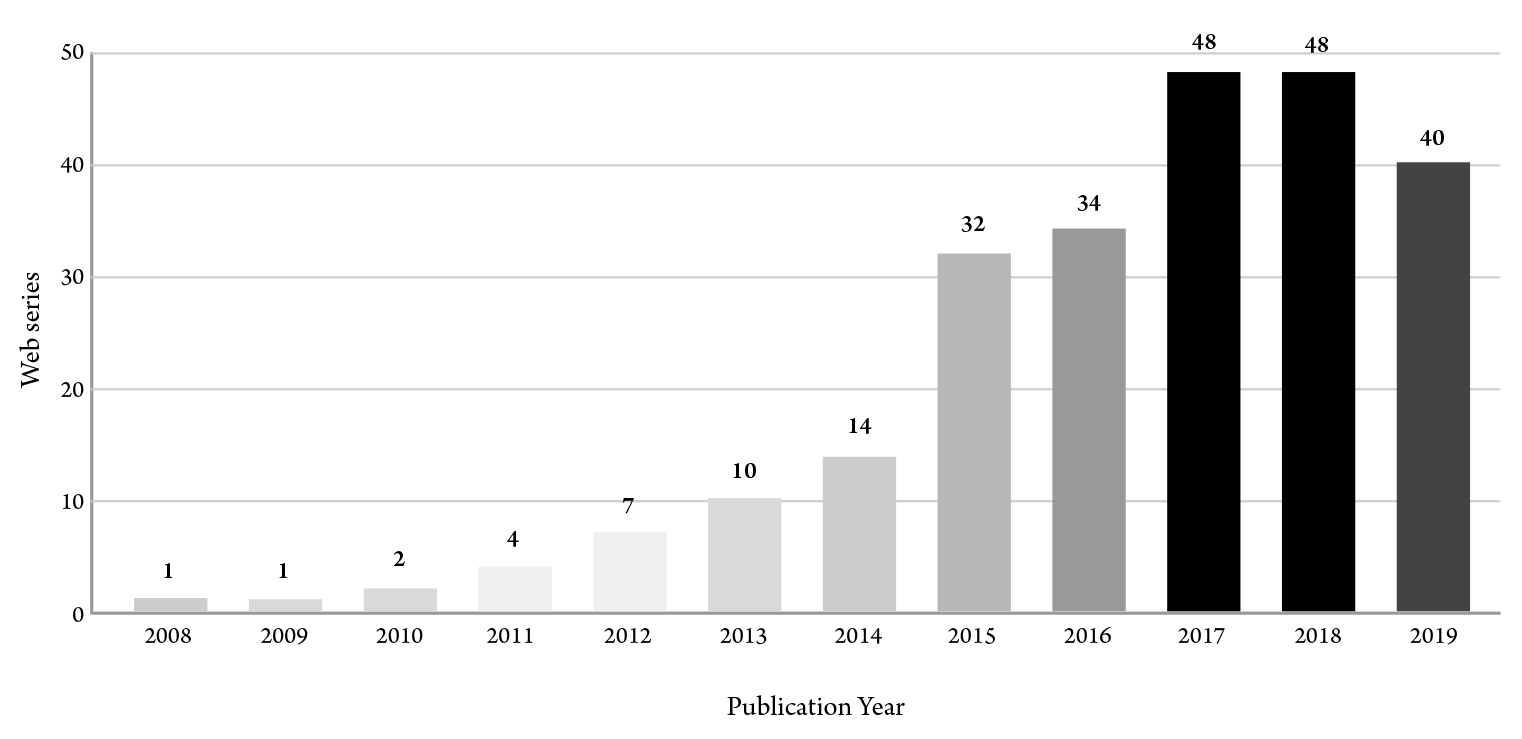
The analysis reveals that Colombian web series have been published on YouTube since 2008. The release year was determined by identifying the date of publication of the inaugural episode of each series. In the initial three-year period (2008-2010), a mere four web series were released. Similarly, four series were published in 2011. Subsequently, the number increased to seven in 2012, ten in 2013, and fourteen in 2014. In 2015, there was a notable increase to 32 new shows. In 2016, there was a slight increase to 34. In 2017 and 2018, there was another considerable rise to 48 new shows each year. Finally, in 2019, there was a slight decline to 40 (Figure 1).
Figure 1. Publication Year of Colombian Web Series on YouTube
Source: Own elaboration.
The increase in publications on YouTube since 2015 could be due to TV channels entering the web series market and the first public calls for funding to support the production of the format.
Something else that would help explain the increase is the appearance of web series festivals and awards, with the launch, for example, in rapid succession of the Festival Internacional de Series Web de Medellín (FIS -MED) in 2016, RoldaWebFest (a web series festival in Roldanillo, Valle del Cauca) in 2017, and Bogotá WebFest in 2018. Also, in 2018, the Festival Internacional de Cine de Cartagena de Indias (FICCI) introduced an award category for web series.
Meanwhile, the reduction in publications on YouTube in 2019 does not necessarily mean there was a decrease in the production of the format. Since 2017, platforms have started appearing on which many professional or industrial Colombian web series are published exclusively.
Place of Origin
Place of origin is important because it defines the extent to which web series are created in the traditional centers of production or, otherwise, also in the periphery.
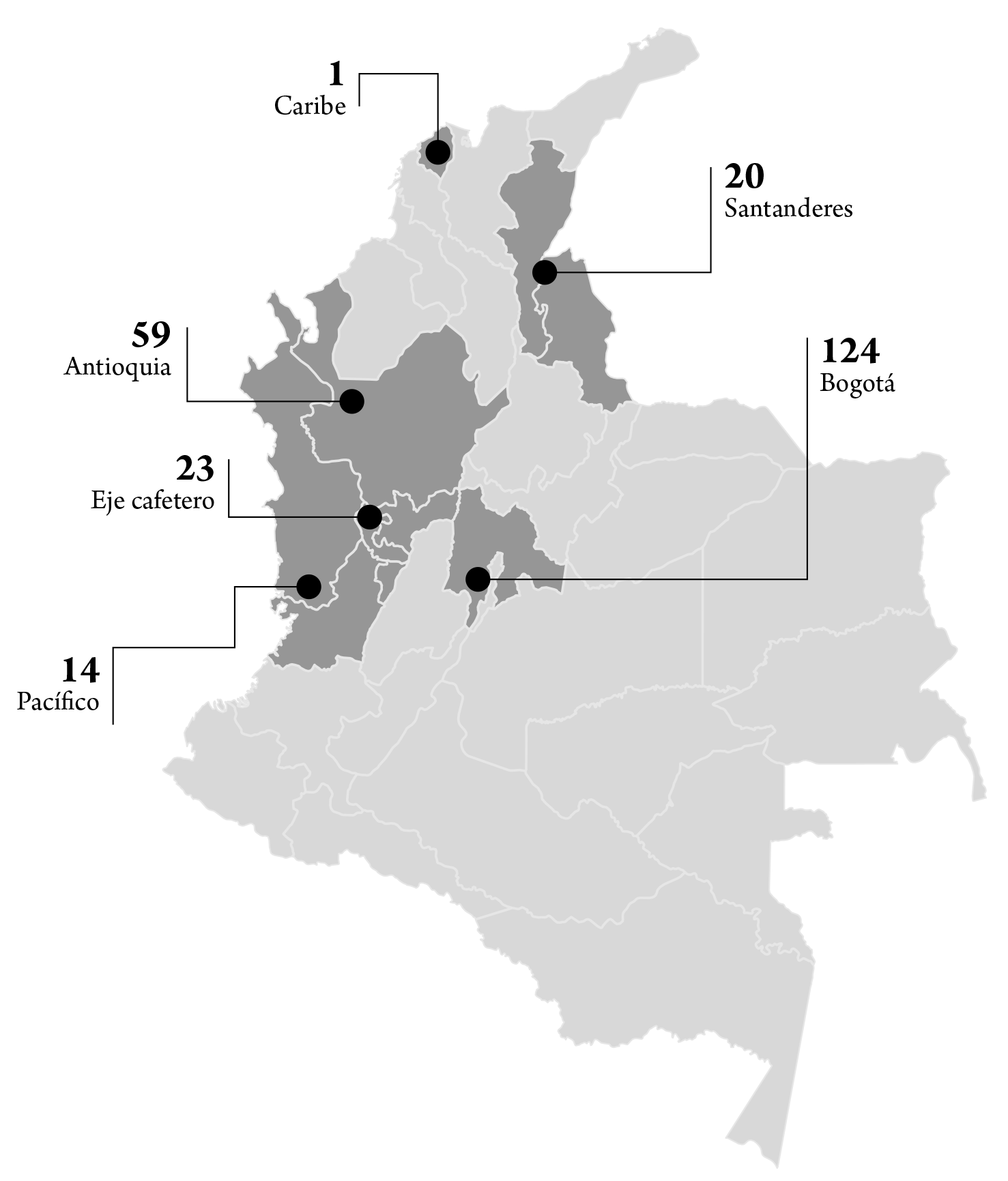
The analysis revealed that, similar to traditional audiovisual production, most web series, 51.5 % (n = 124), were made in the capital, Bogotá, and the remaining 48.5 % (n = 117) were produced in just nine of the country's other 31 departments.
However, it was found that 50.5 % (n = 59) of the 117 web series that were made outside of Bogotá were produced in Medellín and its metropolitan area, the second most important region of Colombia by number of inhabitants, followed by two intermediate cities, Pereira and Bucaramanga, with 18 % (n = 21) and 16.2 % (n = 19), respectively. Note that in these latter three cities, there has traditionally been considerable production from certain universities that have included the creation of web series as part of the practicum on Social Communication and similar degrees. Other cities where web series were identified were Quibdó with 7.7 % (n = 9), Cali and its metropolitan area with 4.3 % (n = 5), and Cúcuta, Manizales, Armenia, and Barranquilla, each with 0.8 % (n = 1).
When the web series is grouped by region on a map of Colombia (Figure 2), production is concentrated in the Andean region, which includes the center, center-west, and northeast of the country.
Aspects of Content
The analysis indicated that most of the 241 web series were comedies (n = 118; 49 %) and dramas (n = 97; 40.2 %). However, other genres were observed, namely thrillers (n = 19; 7.9 %), fantasy and science fiction (n = 5; 2.1 %), action and adventure (n = 1; 0.4 %), and horror (n = 1; 0.4 %).
As for subgenres of comedies (n = 118), sitcoms came top (n = 66; 56 %), followed by parodies (n = 20; 17 %). Of dramas (n = 97), social dramas were most common (n = 43; 44.3 %), followed by melodramas (n = 15; 15.4 %).
We also observed that web series are mostly about children and teenagers or are in everyday family or work settings. Out of the total, 47.7 % (n = 115) were on these subjects; 59.1 % (n = 68) of those were on the former, and 40.9 % (n = 47) on the latter.
Figure 2. Map of Colombia Showing Web Series Production by Regions
Source: Own elaboration.
Further content analysis involved assessing whether the web series manifestly served advertising/promotional or educational/training/ instructive purposes and whether they fostered certain kinds of inclusion. Of the 241 web series in the sample, 19.5 % (n = 47) served such purposes. Specifically, those that promoted products or campaigns amounted to 7.4 % (n = 18), and those of a didactic nature concerning matters such as sexuality, history, ICTs, road safety, and even paying taxes represented 5.3 % (n = 13). In turn, 4.9 % of the series (n = 12) dealt with inclusion issues. Of these, 75 % (n = 9) were associated with the LGBTI+ community and 25 % (n = 3) with people with disabilities. Finally, only 1.6 % (n = 4) of the total dealt with issues related to the Colombian conflict, such as victims of armed warfare between different factions, life with ex-combatants, and border violence.
Aspects of format
Part of this variable involved observing narrative structures, types of images, types of interactivity, and the number of seasons, episodes, and duration.
Concerning narrative structures, the majority (n = 179; 74.3 %) had continuous structures. Meanwhile, 19.5 % (n = 47) contained stand-alone episodes, and only 6.2 % (n = 15) were anthologies (i.e., each episode had different characters and stories).
As for the type of image, 88.7 % (n = 214) used video, 9.2 % (n = 22) used animation techniques, and just 2.1 % (n = 5) used a mixture of both.
Likewise, regarding form, 2.5 % (n = 6) of the sample, despite belonging to the fiction macro genre, used similar structures to non-fiction, such as reality shows and documentaries. Of this percentage, 66.6 % (n = 4) were fake reality shows, and 33.3 % (n = 2) were fake documentaries.
As for interactivity, very few web series sought to engage with their users. In fact, Colombian creators do not tend to make use of this technological possibility. Of the few shows that applied interactivity (n = 6), 1.6 % (n = 4) employed the interrogational form (Prado et al., 2006), whereby users can choose different paths to continue the story. A further 0.9 % (n = 2) used symmetric interactivity (Prado et al., 2006), meaning that these web series used platforms other than YouTube to generate interaction between users and characters. That said, it should be noted that all of the web series on YouTube do allow their users to engage somehow through such actions as commenting, leaving likes or dislikes, pausing, rewinding, fast-forwarding, and so on.
As for the number of seasons, of the 241 web series, 68.5 % (n = 165) only ran for one season, 8.3 % (n = 20) for two, 1.6 % (n = 4) for three, 1.2 % (n = 3) for seven, 0.8 % (n = 2) for four, and 0.8 % (n = 2) for five. It should be noted that each season was registered on YouTube as an independent web series because, on some occasions, the storylines or characters changed between seasons.
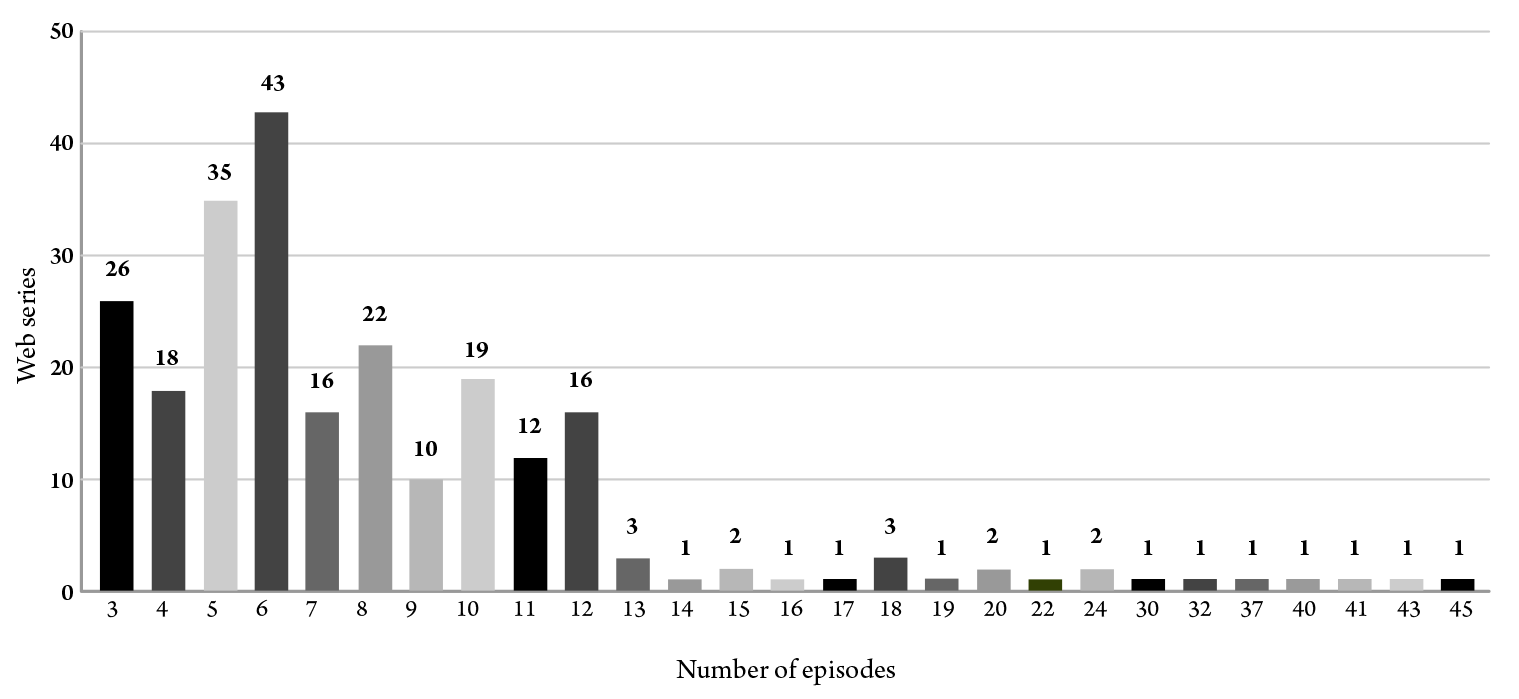
The number of episodes (Figure 3) ranges between 6 and 45 per web series. Specifically, 17.8 % (n = 43) had six episodes, 14.5 % (n = 35) had five, and 10.8 % (n = 26) had three. Although shows of up to 45 episodes were recorded in the systematization matrix, the bulk of them had between 3 and 12 episodes.
Figure 3. Web Series by Number of Episodes
Source: Own elaboration.
To analyze duration, we obtained an average from the sum of the total duration of the web series divided by the total number of episodes. This revealed that the episodes of45.2 % (n = 109) of the shows were three to six minutes long. The second largest number, 32 % (n = 77), lasted between six and nine minutes per episode. In third place, 12 % (n = 29) were between nine and twelve minutes long; in fourth, 3.3 % (n = 8) were between one and three minutes; in fifth, 2.9 % (n = 7) were between twelve and fifteen minutes; in sixth, 2.1 % (n = 5) were between fifteen and eighteen minutes; in seventh, 1.6 % (n = 4) were between eighteen and twenty-one minutes, and finally, 0.8 % (n = 2) had episodes of a longer average duration than twenty-one minutes.
Aspects of Publication
This part observed how episodes were published, whether they were uploaded regularly or not, and whether they were released gradually or at once (as a single release of all episodes). The analysis showed that most web series (n = 207; 85.9 %) were aired episode by episode, while just 14.1 % (n = 34) were aired simultaneously, a practice that has become more widespread in recent years on platforms like Netflix and Prime Video, allowing users to consume them as they wish.
Analysis of periodicity and regularity considered the release times of the 207 web series that were uploaded by episodes, finding that 58 % (n = 120) were released on a constant periodical basis, while the other 42 % (n = 87) premiered at sporadic, irregular intervals.
Of these 120 regularly published web series, 69.2 % (n = 83) did so weekly, 15 % (n = 18) daily, 10.8 % (n = 13) changed their frequency at some point, 5.8 % (n = 5) fortnightly, and one (0.8 %) released one episode per month.
Aspects of Quality
Another aspect considered was quality, based on purely technical criteria. Shows of broadcast quality were identified, meaning products that met the essential parameters to be considered well-made in terms of proper use of image, audio, and editing. Thus, 62.7 % (n = 151) of the shows in the sample offered such quality.
Analysis of the 37.3 % (n = 90) that were not broadcast quality involved noting whether there were slight or notorious flaws in terms of image, audio, and editing; 63.3 % (n = 57) had image flaws, particularly in areas such as framing, movement, and focus, and 44.4 % (n = 40) of these shows were observed to have substandard lighting and color.
However, the greatest deficiencies were observed in sound. Of the 90 non-broadcast quality shows, the audio was poor in intensity and sharpness in 92.2 % (n = 83) of cases.
Finally, a few problems were noted in post-production (editing, graphics, etc.), with just 16.6 % (n = 15) of the sample presenting defects in these aspects.
Aspects of Production
Analysis of this variable began by identifying the directors (whether or not they were mentioned in the credits), as well as their gender and number. It was also noted whether they had sponsors, if they were produced in university or broadcasting industry contexts, and whether they were supported by different types of organizations.
It was also observed that 81.3 % (n = 196) of the shows included credits.
Of the total number of shows (n = 196) that named their directors, 81.6 % (n = 160) had just one such figure, while 19.3 % (n = 38) had more than one director, either as co-directors or with different directors of different episodes. Of the total number of 228 directors who could be identified, 63.6 % (n = 145) had names that would typically be associated with men and 36.4 % (n = 83) with women.
Regarding the producers of these web series, 36.5 % (n = 88) were identified with a production company or agency, while 13.3 % (n = 32) had a TV channel as their main producer.
Of the 32 web series featuring the name of a TV channel, 34.4 % (n = 11) also gave the company name of the production house or agency that made the web series. Hence, so as not to duplicate information about web series produced by professionals, the 88 shows created by a production house or agency were added to the 21 that only gave the name of the channel, for an overall finding that 45.2 % (n = 109) involved at least one TV channel or production house or agency.
We also observed that 14.9 % (n = 36) of the web series had commercial or private brands as their main sponsor. In 13.9 % (n = 5) of these cases, no production company, TV channel, or agency appeared in the credits. However, considering the type of show and the fact that they made reference to brands or products, it can be assumed that they were made by professionals.
Something similar occurred with shows in which a public or government institution appeared in the credits, which amounted to 9.5 % (n = 23) of the total. Of these, 26.1 % (n = 6) mentioned no production company, TV channel, or agency in the credits. But here again, given the quality of the product, they were clearly created by professionals.
Meanwhile, the production of web series related to Colombian higher education institutions accounts for 35.3 % of the sample (n = 85). Of these, 4.70 % (n = 4) were considered professional because they were produced by the audiovisual units of universities to compete in the commercial arena. However, the remainder (n = 81; 95.29 %) were produced by students as part of their academic programs. Consequently, they are considered amateur products.
That said, of the total sample (n = 241), 50.2 % were professional and 49.8 % amateur. Regarding the latter (49.8 %, n = 120), we found that 67.5 % (n = 81) were produced by college students without any help from professionals. Likewise, the names of natural persons, audiovisual or drama groups, or actors were given as the main directors in 32.5 % of cases (n = 39). No support for these from TV channels, production companies or agencies, or universities could be identified.
In short, the distribution of web series by professional (50.2 %) and amateur (49.8 %) directors in Colombia is almost the same.
Discussion and Conclusions
This research contributes to the definition of the technical, narrative, and expressive characteristics of web series by means of a case study of Colombia, a country whose production is prolific, varied, and growing as a result of different professional, institutional, and educational initiatives (Montoya-Bermúdez, 2021; Mora et al., 2021). Using content analysis of qualitative and quantitative data, this study has identified aspects of production, quality, publication, format, content, and evolution over time. It has also proposed an analysis framework created from the academic and professional literature, whose application to other cultural contexts could help to generalize the identified trends, which is so important given the globalized manner in which fiction is consumed today (Montoya-Bermúdez, 2021). By thus defining the current properties of web series, this study fills a gap in systematic knowledge and should encourage more academic and professional debate.
Specifically, this study has observed that the increase in Colombian web series could be related to factors such as the country's audiovisual promotion policies, the creation of festivals, and the incorporation of the broadcasting industry in web series production.
Another of the standout features of Colombian web series is the involvement of similar proportions of professional and amateur producers, while university students also create them as part of their audiovisual training (Montoya-Bermúdez, 2021). However, the results reveal a significant gender gap among directors, with male directors outnumbering female directors by a ratio of two to one. Further research should re-examine these figures and extend the analysis to the presence of women in other roles related to the audiovisual production of web series, as it is possible that women may not hold leadership positions despite being part of the production team. Additionally, future studies should note that this study identified gender based on the names of listed directors, using a binary classification. Future work should consider more inclusive methods, such as directly asking directors or crew members about their gender identity. Future studies could examine this in other contexts.
This research finds that web series are mostly made in places close to the main urban hubs of traditional production, but there is also significant production in peripheral areas. Future studies that use theories on the sociology of entertainment and the processes of cultural production should observe the differences between central and peripheral regions.
Consistent with other studies (De las Muñecas, 2016; Edgerton, 2013; Gordillo, 2012), this research identifies comedy as the majority genre. However, unlike what these authors suggested, a large number of the available shows are dramas. Perhaps due to production costs, there are fewer thrillers, fantasy, science fiction, action, adventure, and horror web series. Another possible explanation for these results is Colombia's strong tradition of producing dramas, particularly soap operas (Cervantes, 2005; Mazziotti, 2006).
The results also indicate that professional producers tend to make comedies while amateurs make dramas. This may be because Colombia's amateur producers find it easier to appropriate dramatic conventions than comedy ones. Future qualitative studies should examine these assumptions.
Coherent with authors who associate web series with young audiences (Adelantado, 2009; Lloret & Canet, 2008), this research finds that shows mostly revolve around themes related to this period of human development. This also supports research that maintains that young Colombians have not only migrated their consumption of serials to the Internet (Hamad, 2018) but also of broadcasting in general (González, 2018). As this is a rising global trend (Rubenking & Bracken, 2021), one can assume that the range of web series will increase as has been predicted (Patalay, 2008), and as these results have shown. Following the COVID -19 pandemic, production should resume its systematically constant growth.
This study observes that a smaller proportion of web series promote projects or services, and another manifestly serves educational purposes. It is also interesting that despite its importance, only a very marginal number of web series deal with issues related to the Colombian conflict. This might also be because they are primarily aimed at young audiences (Adelantado, 2009; Lloret & Canet, 2008).
Regarding format, and as a contribution to the traditional debates on the standard duration of web series (Edgerton, 2013; Ellingsen & Taylor, 2019; Lloret & Canet, 2008; Patalay, 2008; Pierce & Tang, 2012), this study finds that episodes are mostly between three and six minutes long. Only a residual number of episodes last more than fifteen minutes. Given that YouTube now supports longer videos (Hernández, 2011), other authors (Adelantado, 2009; Barrasa, 2015) would seem to be correct in claiming that web series are suited to the usual consumer habits of digital natives.
That said, according to these results, episode duration varies widely, from three minutes to twenty-one minutes or more, which is consistent with authors who dismiss the relevance of duration as a defining characteristic of the format (Hernández, 2011), although it does seem to be a factor in the minds of the audiences they are aimed at (Adelantado, 2009; Barrasa, 2015). However, given that many festivals do not admit projects longer than twenty minutes (Ellingsen & Taylor, 2019), it could be concluded that, although this research has found that the duration ofweb series episodes is variable, they hardly ever exceed twenty minutes. Either because festivals have encouraged it or due to the influence of current consumption trends, web series episodes are still shorter than those of their televised counterparts (Edgerton, 2013).
This research observes that the number of seasons and episodes of web series is also variable. Most tend to run for a single season, and the proportion of additional seasons decreases progressively. The number of episodes per season is also variable, ranging widely between 6 and 45 episodes per series. However, this research observes that practically all web series have between 3 and 12 episodes. The most frequent numbers of episodes are six, five, and three, respectively. Note, however, that this study defined web series as shows having three or more episodes, following Hernández (2011). Shows with fewer episodes were not included in the sample.
As for narrative structures (Comparato, 1999; Mittell, 2006), most web series have ongoing storylines across all episodes, and fewer consist of standalone episodes. Anthologies, whose episodes have different characters or stories united by a common theme, are marginal.
This study observes that web series are essentially video products, perhaps due to the higher costs of CGI. They also under-exploit the possibilities for interactivity offered by the Internet. The few interactive web series in the sample invite users to choose paths to continue the story or, to a lesser extent, use other platforms to generate interaction between users and characters. However, despite the potential of interactivity being underutilized in Colombian web series, in contrast to traditional television, their utilization of the Internet as a medium positions them within the category of Social Media Entertainment, as defined by Cunningham and Craig (2019). This encompasses an ecology of new screens driven by intrinsically interactive technologies that encourage active user participation through comment and like sections, emoticons, and shared posts, friends, and followers (p. 10).
Similar to television, this study has found that far more web series are released in episodes rather than as whole seasons at once. They also tend to be uploaded to YouTube on a regular, weekly basis, a tradition inherited from television.
Finally, it has been observed that most web series are broadcast quality (professional) with no image movement or framing, audio, or editing flaws. This not only signals respect for the format among creators but also their mastery of audiovisual codes and techniques. Lower-quality web series fundamentally feature audio-based shortcomings, while there are fewer image-related and hardly any post-production deficiencies. Future studies in different cultural contexts could replicate these observations. They should also take into account the perceptions of potential audiences when assessing their audiovisual quality.
This study confirms that web series are the result of the remediation (Bolter & Grusin, 2000) of earlier language and media. In fact, the very term 'web series' combines the notions of a particular narrative structure (serial) and a medium (the web) that takes the (audiovisual) content of another medium (television) to make it its own.
References
Adelantado, E. (2009). Entretenimiento móvil: de los contenidos de la industria a los contenidos del usuario. In M. De Aguilera & M. Meere (Eds.), Una tele en el bolsillo. La televisión en el teléfono móvil: contenidos, formatos, audiencias (pp. 41-67). Editorial Círculo de Estudios Visuales AdHoc.
Altman, R. (2000). Los géneros cinematográficos. Paidós.
Aquilina, P. (1999). Teen cyberseries gear up for TV crossover. Kidscreen. https://kidscreen.com/1999/04/01/25035-19990401/?utm_source=rss&utm_medium=rss&utm_campaign=25035-19990401
Barrasa, Y. (2015). Series web: revolución creativa en las redes. Revista Arcadia. https://www.semana.com/periodismo-cultural-revista-arcadia/articulo/series-web-revolucion-televison-web/42929/
Bassaget,J., & Burkholder, M. (2019). Short, Narrative & Serialized: A Complete Guide to the Web Series Phenomenon. ePub.
Bolter, D., & Grusin, R. (2000). Remediation: understanding new media. MIT Press.
Brophy-Warren, J. (2009). How the Web Series 'The Guild' Stays Successful: A Gaming Obsession Becomes a Starring Role. The Wall Street Journal. https://www.wsj.com/articles/SB10001424052970203706604574371032925896794
Brundidge, J. (2010). Political discussion and news use in the contemporary public sphere: The "accessibility" and "traversability" of the Internet. Javnost - The Public, 17(2), 63-82. https://doi.org/10.1080/13183222.2010.11009031
Caro, F., García, M., & Bezunartea, O. (2014). La metodología mixta de investigación aplicada a la perspectiva de género en la prensa escrita. Palabra Clave, 17(3), 828-853. https://doi.org/10.5294/pacla.2014.17.3.11
Chwastiak, M. (1998). Webisodics: A Brief History. The Sideroad. http://sideroad.com/gethooked/column10.html
Cervantes, A. (2005). La Telenovela colombiana: un relato que reivindicó las identidades marginadas. Investigación & Desarrollo, 13(2), 280-295. https://www.redalyc.org/pdf/268/26813203.pdf
Christian, A. (2018). Open TV: Innovation Beyond Hollywood and the Rise of Web Television. New York University Press.
Clark, D. (1997). Net Storytellers, Beware: This Audience Talks Back. The Wall Street Journal. https://www.wsj.com/articles/SB858292931139268500
Comparato, D. (1999). La serie dramática. In L. Vilches (Comp.), Taller de escritura para televisión (pp. 19-54). Gedisa.
Copeland, J. (1997). American Cybercast Bankrupt. Failure for a big promoter of the Web as the new television. E! Online. https://www.eonline.com/news/33971/american-cybercast-bankrupt
Cunningham, S., & Craig, D. (2019). Social Media Entertainment: The New Intersection of Hollywood and Silicon Valley. New York University Press. https://doi.org/10.18574/nyu/9781479838554.001.0001
De las Muñecas, R. (2016). Webseries: La (r)evolución audiovisual [Doctoral dissertation, Universidad del País Vasco]. https://dialnet.unirioja.es/servlet/tesis?codigo=174468
Diego-González, P., & Herrero-Subías, M. (2010). Desarrollo de series online producidas por el usuario final: el caso del videoblog de ficción. Palabra Clave, 13(2), 325-336. https://doi.org/10.5294/pacla.2010.13.2.6
Edgerton, K. (2013). Byte-sized TV: Writing the web series [Doctoral dissertation, Massachusetts Institute of Technology].
Ellingsen, S., & Taylor, S. (2019). Writers, producers and creative entrepreneurship in web series development. In C. Batty, M. Berry, K. Dooley, B. Frankham, & S. Kerrigan (Eds.), The Palgrave Handbook of Screen Production (pp. 181-192). Palgrave Macmillan. https://doi.org/10.1007/978-3-030-21744-0_14
González, O. (2018). Apropiación y hábitos de consumo de jóvenes en Colombia frente al contenido de los youtubers. Dixit, 28, 12-21. https://doi.org/10.22235Zd.v0i28.1578
González de Garay, B. (2009). Ficción online frente a ficción televisiva en la nueva sociedad digital: diferencias de representación del lesbianismo entre las series españolas para la televisión generalista y las series para televisión. Icono, 14(2). https://eprints.ucm.es/id/eprint/9856/
Gordillo, I. (2012). La autorrepresentación del andaluz en web-series. Palabra Clave, 15(1), 54-81. https://doi.org/10.5294/pacla.2012.15.1.3
Hamad, Z. (2018). Audiencias de series web en Colombia: características del consumidor y perfil de sus hábitos de consumo [Master's thesis, Universidad de La Sabana]. https://intellectum.unisabana.edu.co/handle/10818/34045
Hernández, P. (2011). Las webseries: evolución y características de la ficción española producida para internet. Revista Faro, (13), 94-104. https://dialnet.unirioja.es/servlet/articulo?codigo=4159110
Hernández-Sampieri, R., & Mendoza, C. (2018). Metodología de la investigación. Las rutas cuantitativa, cualitativa y mixta. McGraw-Hill Education.
Igartua, J. (2006). Métodos cuantitativos de investigación en comunicación. Bosch Comunicación.
Jenkins, H. (2006). Convergence Culture: Where Old and New Media Collide. New York Press.
Jung, W. (2017). A study on storytelling characteristic of super-compressed web drama "72 seconds". Journal of Korea Multimedia Society, 20(7), 1148-1155.
Krippendorff, K. (2004). Content Analysis. An Introduction to Its Methodology. Sage Publications.
Lee, C. (2019). Web series, YouTube, and politics: Affective and emotional dimensions of WIGS Lauren's user comments. Social Media + Society, 1-12. https://doi.org/10.1177%2F2056305118820766
Lloret, N., & Canet, F. (2008). Nuevos escenarios, nuevas formas de expresión narrativa: La Web 2.0 y el lenguaje audiovisual. Hipertext.net, (6). https://arxiu-web.upf.edu/hipertextnet/numero-6/lenguaje-audiovisual.html
López, D. (2010). Webseries: Nuevo fenómeno de experimentación audiovisual y entretenimiento. http://issuu.com/diegodario/docs/webseries
Lotz, A. (2014). The Television Will Be Revolutionized. New York University Press.
Mazziotti, N. (2006). Telenovela: industria y prácticas sociales. Editorial Norma.
Meltwater. (2024). Digital 2024 Colombia: The essential guide to the latest connected behaviours. https://datareportal.com/reports/digital-2024-colombia
Mittell, J. (2006). Narrative Complexity in Contemporary American Television. The Velvet Light Trap, (58), 29-40. https://doi.org/10.1353/vlt.2006.0032
Montoya-Bermúdez, D. (2021). Las series web. Colombia como estudio de caso [Doctoral dissertation, Universidad Autónoma de Barcelona]. https://hdl.handle.net/10803/675151
Montoya-Bermúdez, D. (2022). Caracterización de la producción de series web en América Latina. In. L. Tabares; A. Valencia & E. Amaya (Comp.), Discursos y contenidos en el entorno digital. Análisis desde América Latina, (pp. 201-221). Editorial Universidad Pontificia Bolivariana. http://hdl.handle.net/20.500.11912/10453
Montoya-Bermúdez, D., & García-Gómez, H. (2016). Estructuras narrativas en relatos cortos y señalizados para la web. Anagramas Rumbos y Sentidos de la Comunicación, 15(29), 103-118. https://doi.org/10.22395/angr.v15n29a5
Montoya-Bermúdez, D., & Soto-Sanfiel, M. (2023). Narrative structures in Colombian fictional web series published on YouTube. Journal of Screenwriting, 14(2), 191-207. https://doi.org/10.1386/josc_00123_1
Mora, C., Puccini, A., & Uribe, E. (2021). De los medios a la Convergencia. La formación del espacio audiovisual ampliado en Colombia. Mediaciones de la Comunicación, 16(1), 59-85. https://doi.org/10.18861/ic.2021.16.1.3097
Neale, S. (2000). Genre and Hollywood. Routledge.
Neuendorf, K. (2017). The Content Analysis guidebook. Sage. https://doi.org/10.4135/9781071802878
Niqui, C. (2014). Los primeros 20 años de contenidos audiovisuales en Internet. 1000 obras y webs. Editorial UOC.
Otzen, T., & Manterola, C. (2017) Técnicas de Muestreo sobre una Población a Estudio. International Journal of Morphology, 35(1), 227-232. http://dx.doi.org/10.4067/S0717-95022017000100037
Patalay, A. (2008), All smiles as web shows come of age. The Guardian http://www.theguardian.com/culture/2008/dec/14/internet-web-series
Pierce, L., & Tang, T. (2012). Refashioning television: Business opportunities and challenges of webisodes. International Journal of Business and Social Science, 3(13), 163-171.
Piñeiro-Naval, V. (2020). La metodología de análisis de contenido. Usos y aplicaciones en la investigación comunicativa del ámbito hispánico. Communication & Society, 33(3), 1-16. https://doi.org/10.15581/003.33.3.1-15
Prado, E., Franquet, R., Ribes, X., Soto, M., & Fernández, D. (2006). Televisió interactiva. Simbiosi tecnológica i sistemes d'interacció amb la televisió. Quaderns del CAC. https://dialnet.unirioja.es/servlet/articulo?codigo=8471791
Rozados, A., Calvete-Lorenzo, S., & Sosa- Fernández, R. P. (2024). Producciones audio-visuales en formato vertical: el caso de Snap Originals. El consumo de ficción en 9:16. Palabra Clave, 26(4), e2646. https://doi.org/10.5294/pacla.2023.26.4.6
Ruano, S. (2009). Internet y la telefonía móvil: nuevos soportes para distribuir contenidos audiovisuales. Razón y Palabra, (68). http://www.redalyc.org/articulo.oa?id=199520297025
Rubenking, B., & Bracken, C. (2021). Binge watching and serial viewing: Comparing new media viewing habits in 2015 and 2020. Addictive Behaviors Reports, 14. https://doi.org/10.1016/j.abrep.2021.100356
Sáez, C. (2010, February 3-5). Series para móviles y series por Internet: el lenguaje de las nuevas pantallas y su aterrizaje en la televisión española. In II Congreso Internacional Comunicación y Desarrollo en la Era Digital, Málaga, España. https://dialnet.unirioja.es/servlet/articulo?codigo=5405032
Sánchez, J.L. (2018). Historia del cine. Teorías, estéticas, géneros. Alianza Editorial
Schlütz, D. (2016). Contemporary Quality TV: The Entertainment Experience of Complex Serial Narratives. Annals of the International Communication Association, 40(1), 95-124. https://doi.org/10.1080/23808985.2015.11735257
Segarra-Saavedra, J. (2016). Panorama español de las webseriespublicitarias. Aproximación transmediática desde la perspectiva del branded content [Doctoral dissertation, Universidad de Alicante]. https://dialnet.unirioja.es/servlet/tesis?codigo=61941
Seiter, E. (2003). Television and the Internet. In J. Turow & A. Kavanaugh (Eds.), The Wired Homestead. An MIT Press Sourcebook on the Internet and the Family (pp. 93-116). The MIT Press. https://doi.org/10.7551/mitpress/7252.003.0007
Simelio, N. (2010). La representación de las relaciones sociales en las series de ficción digitales creadas específicamente para Internet [Presentation]. Congreso Euro-Iberoamericano de Alfabetización Mediática y Culturas Digitales, Sevilla, España. http://hdl.handle.net/11441/5627
Song, B. (2019). A study on the intermediality of Korean web dramas[Doctoral dissertation, Hanyang University].
Strangelove, M. (2010). Watching YouTube. Extraordinary videos by ordinary people. University of Toronto Press. https://doi.org/10.3138/9781442687035
Uribe-Jongbloed, E., & Corredor-Aristizábal, M. A. (2020). Creative industries policies and conditions of cinema labor in Colombia in the 21st century. Creative Industries Journal, 13(3), 228-243. https://doi.org/10.1080/17510694.2019.1709016
Williams, D. (2012). Web TV Series: How to Make and Market Them. Kamera Books.